Showing posts with label Discussions Magazine. Show all posts

Saturday, February 22, 2014

Songs That KROQ Forgot #1


SONGS THAT KROQ FORGOT:

Back in the late '70s and early '80s, if you were a fan of New Wave, Post-Punk, Power Pop, and Synthpop and you lived in Southern California, your radio station of choice was probably KROQ (106.7 FM). Back in the day, KROQ didn't follow trends like they do now - they set them!  KROQ would play singles, album cuts, b-sides and anything else that suited their fancy.  And they didn't just play stuff that was released in the U.S.!  They would also play import singles and album cuts and were responsible for many bands gaining attention from the American labels in the first place.

When KROQ would jump on a song, they'd play it in medium to heavy rotation for a certain amount of time and then it would disappear from their playlists entirely.  As the '80s became the '90s (and when KROQ went from great to ghastly), there were hundreds and thousands of songs that KROQ once supported heavily that seemingly evaporated into thin air and would never make an appearance on their 'flashback' playlists. The once-great radio station had moved on like many of us do...

But what about those lost songs?  The ones yo used to love so much... What about the memories they conjure up when you hear them again after decades of being hidden away in the darkened recesses of your mind?  

Do they remind you of stolen kisses with a long-lost sweetheart?  

Do they remind you of driving to McDonalds during lunch hour in your senior year?  

Do they remind you of driving up PCH along the beach and playing these songs as loud as possible?

Do they remind you of life-long friendships?  Long lost loved ones?

Well, they should because they are the soundtrack of your life.


I am here to remind you of those songs you loved (or loathed) back then... the songs that ushered in a music revolution that was already becoming a little stale by the time MTV became popular.  These songs once made a difference in our lives.  Like Johnny Mann, they made us 'stand up and cheer'.  The truth of the matter is, they STILL mean something.  They are the heartbeat of a generation that is now closer to retirement age than they are their high school heyday.  These songs made it a lot easier to get through the day and that is all that matters.  Let them take you back to a time when your heart was still full love and your youth was still...er.. young!

P.S.  Some of the bands are still remembered while others are unjustly forgotten... but these gems from the late '70s and early '80s are still as wonderful as ever.  They are the SONGS THAT KROQ FORGOT!


PART ONE:


BRIAN BRIGGS/"See You On The Other Side"
 (some used to call this "Goodbye Frankie")


ICEHOUSE/"We Can Get Together"


PAT WILSON/"Bop Girl"
(yes, that is a 15 year old Nicole Kidman co-starring in this video!)

http://www.youtube.com/watch?v=BDNupK1RkdY


THE DICKIES/"(I'm Stuck In A Pagoda With) Tricia Toyota"


DEPECHE MODE/"Get The Balance Right"


MENTAL AS ANYTHING/"If You Leave Me..."


XTC/"Helicopter"


KID CREOLE & THE COCONUTS/"Stool Pigeon"


SQUEEZE/"In Quintessence"


WIDE BOY AWAKE/"Chicken Outlaw"

Friday, September 27, 2013

SPAZ Reviews DOG TRUMPET's Medicated Spirits!


DOG TRUMPET

MEDICATED SPIRITS


For a quick rundown on Dog Trumpet, please see my earlier post about them HERE.


         For over 35 years, Reg Mombassa and Peter O'Doherty have been creating some of the most distinctive music in Australian history.  While they were two-fifths of Australian legends Mental As Anything from 1976 to 2000, they were crucial to that band's success. Martin Plaza (guitar and vocals) and Greedy Smith (keyboards and vocals) may have been in the spotlight a bit more, but Reg's slide guitar and Peter's inventive bass playing helped to create and fuel the Mental's unique sound.  The fact that Reg and Peter wrote plenty of songs for the band only solidified their standing as two of Australia's premiere talents.  When The Mentals went on hiatus at the end of the '80s, Reg and Peter formed Dog Trumpet. Their debut album, Two Heads One Brain (1991), continued in the Mentals tradition of expertly produced Roots Rook/Pop.  The Mentals got back on track in the mid '90s but that didn't stop Dog Trumpet from releasing their next album, Suitcase, in 1996.  Reg and Pete left Mental As Anything in 2000 in order to focus on Dog Trumpet and their art projects.  The duo released three more albums from 2002 to 2010 (Dog Trumpet, Antisocial Tendencies and River Of Flowers), all of which were gloriously unique and inspiring. 

Now, three years on from River Of Flowers, Reg and Peter have released their masterpiece - Medicated Spirits.

While it's not entirely different from their last few albums, the duo have come up with their finest batch of songs to date and released in as a double album... on two CDs! It doesn't get much better than this, to be honest.  19 songs and every one of them a gem. Reg and Peter don't just write Pop songs - they paint aural pictures that they fill in with different shades, colors and genres. But with that being said, the tracks are still very earthy and warm. The charm in Dog Trumpet's music is that there is such beauty in their simplicity.  Dog Trumpet sound like no one else and that is a rarity in this day and age. The album is awash with acoustic instruments and delicious harmonies that offer up an almost magical feel to each track. This isn't music created to shift units - it is music that connects with the listener on many different levels.  Shifting units is just a plus. Fans of Alt-Country, Pop, Rock 'n' Roll, Blues and Folk would do themselves a favor by clicking on one of the links above and buying Medicated Spirits immediately

Highlights: 

     The album's opener, the instrumental "Elizabethan", is similar in spirit and style to some of Paul McCartney's early '70s instrumental pieces on the McCartney album. Yes, it's that good.  

     "Speed Of Light" kicks things up a notch with it's heavy fuzz bass and Psychedelic Folk groove. Peter's affinity for Psych-influenced melodies is immediately apparent here.  

     Reg's "Made In The World" is a catchy Blues/Folk ditty with a keen Pop sense to it  You will find yourself singing this track to yourself and your friends for weeks afterwards (and MY friends can verify because that's just what I've been doing since I first played the album!)

      "Bored Wife" has been one of my favorite Dog Trumpet songs since it appeared on an EP two decades ago.  They've re-recorded it for this project and it has lost none of it's emotive power in this new updated version.  It is touching and melancholic, although a bit more raw and loose.  

     "Ray Davies And The Kinks" sounds nothing like Ray Davies and The Kinks although the lyrics paint a glorious picture of a road trip listening to Ray and the boys, and that is just as fun.  More Muswell Hillbillies than Kinda Kinks, its a track that will earn repeated listenings on your next road trip.  Who needs Ray when you have Reg?

     "Methylated Spirit" has a wonderful hook that is accented by some fantastic harmony vocals that sound almost other-worldly. 

     "What Falls Away" is a splendid Pop song from top to bottom.  Again, the backing vocals really help make the song the perfectly constructed recording that it is. 

     "Camel Rock" features fantastic lead vocals by band member Bernie Hayes, a performance that now has me trying to track down his two solo albums. Hayes gave a stellar vocal performance on "Bloomsbury Birds" from their album Antisocial Tendencies as well.  

     "Broke In Many Parts", "Tell Me" and "Moon And Star" have some of the prettiest melodies that Peter has written.

     While they don't sound like old Mentals recordings, songs like "Telegraph Pole" and "Arriving At The End" wouldn't sound out of place on their albums Get Wet and Espresso Bongo


     I could go on and talk about every single track on the album, but my goal here is to inspire you to run out and buy Medicated Spirits, not to bore you with my personal love affair with this double disc delight.  Dog Trumpet have recorded the best album of their career thus far as well as one of the best albums of the year.  Not bad for a couple of fellas who've been doing this for nearly 40 years... not bad at all!

Peace, love and puppies,
Stephen SPAZ Schnee


Ten Reasons Why THE CLASH Were The ONLY Band That Mattered!


Ten Reasons Why 
THE CLASH 
Were The Only Band That Mattered


1. JOE F***ING STRUMMER

2. MICK F***ING JONES

3. PAUL F***ING SIMONON

4. TOPPER F***ING HEADON

5. LONDON F***ING CALLING


6. "Train In Vain"


7. "Safe European Home"

8. "The Magnificent Seven"

9. "Janie Jones"


10. And just about every other f***ing song 
THE CLASH recorded!


Here are three ways to (re)discover THE CLASH:


SOUND SYSTEM Box Set
Stunning 12 disc boxset containing 11 CDs + DVD. All newly remastered by The Clash with award-winning engineer Tim Young! Three CDs featuring rare tracks, demos, non-album singles and B-sides. DVD including unseen Julian Temple footage, early Super 8 film shot by Don Letts, all the band's promo videos and previously unseen live footage. Owner's Manual booklet. Folder containing reprints of 'Armagideon Times 1 & 2 and Armagideon Times 3 (new edition of fanzine compiled and designed by Paul Simonon). Merchandise; dog tags, badges, stickers and a Future Is Unwritten note book designed by Harland Miller. An exclusive photo poster. Oh, and their first five albums spread over eight discs!

Five Studio Albums (8CD Box)
2013 eight CD box set containing digitally remastered editions of the first five albums from the British Punk quartet, often referred to as 'the only band that matters'. Each album comes in vinyl replica packaging. Contains the original UK version of the self-titled first album, Give 'Em Enough Rope, London Calling (on two CDs), Sandinista! (on three CDs) and Combat Rock. All CDs come housed in a box designed by the band.


THE CLASH HITS BACK
2013 two CD set containing digitally remastered versions of 33 of the band's iconic tracks. The tracklisting is sequenced from the band's legendary Brixton Fairdeal show in 1982 and contains the best studio recordings of the full set, plus eight additional iconic tracks. It comes with the original setlist, handwritten by Joe Strummer which he would tape to the back of his Telecaster before each gig. "Every show was different. Joe would spend a lot of time composing the running order, considering dynamics, emotional impact and the key the songs were in. This record is based on Joe's setlist from The Casbah Club UK Tour, Brixton Fairdeal, 10th July 1982". -Mick, Paul and Topper.

SPAZ Interviews KNOX of THE VIBRATORS!

BUZZ BUZZ BUZZ:

An EXCLUSIVE Interview with 
KNOX from British Punk icons
 THE VIBRATORS

By Stephen SPAZ Schnee
(An edited version of this interview ran in Discussions Magazine)  


     In 1955, Rock ‘n’ Roll emerged from the American underground and changed the course of musical history. From Chuck Berry and Elvis Presley in the ‘50s to The Beatles and The Rolling Stones in the ‘60s, Rock evolved from its somewhat innocent roots and had become a money-making behemoth by the mid ‘70s, at which time Prog Rock and sensitive singer/songwriters fought for equal – or better - placement on the charts. In 1976, the year Rock turned 21, Punk emerged from the UK and turned it all upside down.  Clearing away the excesses of corporate Rock like weeds being ripped from a garden, Punk tore the slightly-aged genre right back down to its roots.  For the first time since its inception, Rock was raw, sweaty, wild, and filled with youthful abandon again.  Bands such as Sex Pistols, The Clash, The Jam, The Stranglers, Buzzcocks and The Damned were scoring actual chart hits in the UK while creating a stir in the U.S. as well. 
     Fighting the good fight right alongside these higher profile bands was The Vibrators, one of the few original UK Punk bands who continues to tour and record nearly 40 years after their formation.  Led by original members Ian KNOX Cornochan (vocals/guitar/songwriting) and John EDDIE Edwards (drums), The Vibrators have gone through numerous line-up changes throughout the years, but have remained determined, focused and eager to share new music with their fans.  From their early days signed to Epic/CBS and the hits “Baby, Baby”, “Automatic Lover”, and “Judy Says (Knock You In The Head” to their 2013 album On The Guest List, The Vibrators are unafraid to embrace their past as they continue to creatively move forward. 
    While Eddie tirelessly tours with The Vibrators, Knox recently retired from the road but has still been active with songwriting and providing creative energy and support.  With the band on the road constantly through 2013, their legacy is being celebrated with Greatest Punk Hits, a collection that contains recent studio versions of many of their finest tracks. It allowed Knox and the boys to approach the songs with a seasoned yet refreshing attitude, keeping the arrangements pretty darn close to the originals without sounding like their trying to duplicate themselves. 
     Stephen SPAZ Schnee caught up with Knox, who kindly shared his thoughts on Punk and The Vibrators long and influential career…


SPAZ:  There’s a new collection on the market, Greatest Punk Hits, which features the band revisiting some of their finest songs.  How are you feeling about this release as well as the band’s most recent studio album On The Guest List?
KNOX: It’s always great to have more music coming out. It makes you feel that what you are doing, and what you did, is still relevant today and hopefully people will like it. The Vibrators have been continually making new studio albums, we’ve made something like seventeen. This keeps the band active, as opposed to a touring museum piece, whereby the band becoming its own tribute band. So it’s great to have both a new studio album (On The Guest List on Cleopatra Records), and a greatest hits album (Greatest Punk Hits on O-Rama). The Greatest Punk Hits album has different versions of the original tracks and should be very interesting for a lot of people.

SPAZ:  While your songs have always been perfectly suited for the Punk movement, they really seem to be rooted in classic Rock ‘n’ Roll tradition.  What types of bands were you playing in before Punk came along?
KNOX: I was in bands at school in the early ‘60s which primarily only played covers, then at art school I was in several kinds of R&B bands, then a Psychedelic band called The Dream Machine. Years later when I began writing songs I was very influenced by the Velvet Underground, plus I suppose all the cover songs I’d been doing. So the later bands I was in started doing my songs.  Despair was doing basically only my songs, whereas a later band Lipstick did a mixture of my songs and covers. They were both three-piece bands, and I liked Metal guitar solos and Jimi Hendrix so that got incorporated into the music as well. Also it’s fair to say a lot of it was technologically driven, you know things like fuzzboxes, phasing pedals, wah-wah pedals, that sort of thing. I don’t think I’d be doing music if people hadn’t discovered electricity and invented the electric guitar and amplification!

SPAZ: I’ve always wondered: where did the name Knox come from?
KNOX: It’s a shortened version of my surname Carnochan. I was at an all boys’ school and everyone called each other by their surnames, I don’t know if this still happens. Anyway my surname was too difficult, it got shortened to Carnocks and then just to Knox.

SPAZ: When did you first become aware of the initial Punk movement in the UK? 
KNOX: I think it was Pat Collier, our bass player and also a songwriter in The Vibrators, who noticed it. It was sort of ‘over there’ as it were and suddenly, as we were playing fast aggressive songs, we were included in it. Subsequently we had a small part of helping shape Punk because we were in at the beginning.

SPAZ: Do you feel that the movement’s hype became more important than the music?
KNOX: Possibly. It was a gift for the press: the look, the aggressive music, trouble at gigs, the political thing, so of course the press had a field day dressing it up and exaggerated it to sell papers, plus half-orchestrating things. If you stick a camera on someone something will happen. I don’t think the bands minded - after all it was great publicity. Nowadays it’s a kind of trade-off. People like using the term and the clothes and the attitude, but hopefully some of it rebounds back to shine a light on the music. Also I think it’s both funny and also a shame that sometimes people wearing a Punk T-shirt with a band name on it probably know nothing about the band or the music. Plus what it was like in 1976-7.

SPAZ: During the early days of Punk, were you friends or competitors with a lot of your contemporaries like The Clash, The Jam, 999, The Stranglers, et al?
KNOX: I think it must have been a mixture. You wanted the attention but then again initially it was a small movement and felt very much like an ‘us against the world’ kind of thing. So for that reason you were very friendly towards the other bands.

SPAZ: What do you remember about those first few years of the Punk movement?
KNOX: I suppose it was the fact that when I grew up I might have dreamt of being in a slightly famous band, and then somehow I was. When I was at the grammar school it was never even a remote career option, being in a band was something that only seemed to happen to chosen people and was going on somewhere else. I know that’s all changed now. Everyone today knows people in bands. When we started The Vibrators we were just a very small band, lugging our gear around to pubs to play, often to people who probably weren’t terribly interested. Then a year or so later we had roadies, trucks, and were on the TV, it was astonishing. We were often the first Punk band in some towns and there’d be people there who’d read about Punk and violence and you’d get your fair share of stuff thrown at you and spat on. Sometimes it was funny and sometimes quite frightening, but you wanted to play so you carried on, and in the end, we won the day.

 (Photo credit: Fishbones)

SPAZ: The Vibrators didn’t adhere to any Punk formula when it came to their records.  Whose brilliant idea was it to feature a sax solo on “Judy Says”?
KNOX: That would have been Don Snow’s idea. He was in that particular line-up of the band and played keyboards and sax. He was a very talented musician and added a lot of bits, for instance the ending of that song, that very obvious up and down bit, etc., and the extra bits on the end of one line in the chorus, I think they were all his ideas. Also I think people now think of Punk music as this… what I call ‘identikit’ Punk - you know the one look and the one sound. When Punk started, it was really varied - although maybe it was also partly New Wave as well.

SPAZ: The band has been releasing music on a semi-regular basis for over 30 years.  Are you frustrated by the band’s ‘cult’ or ‘underground’ status over the years?  Or is this where you prefer to be, success wise?
KNOX: I’d have liked the band to have been more successful, but I think it’s entirely our fault we weren’t. The name kept us off the radio and TV, enough to make a difference and we never got a manager after the first few years and I think without that you will have trouble getting noticed, you know, getting on the right tours, the radio, interviews, etc. Without it you’re condemned to being a cult band. It has its advantages, I mean I don’t have to fight my way though a load of photographers to go down to the shops. And I don’t have to talk to accountants and gardeners. But sometimes I wish I had a bit more money, but that’s life.

SPAZ:  My favorite period of the Vibrators’ recording career was actually the ‘80s and ‘90s because it seemed the band concentrated more on songcraft than being a Punk band.  What do you remember about this time during the band’s career? Great albums like Fifth Amendment, ‘Buzzin’, Hunting For You, Guilty and so many others…
KNOX: Yes, one time when we were on Revolver Records the guy there Paul Birch suggested we record more rock kind of material, Punk was not a big deal at the time. But although we made some great records I felt we were in danger of going down a hole between rock and Punk rock. Neither-one-or-the-other so the fans would be disappointed and confused. I think it freed up the choice of material we recorded so we did some good stuff, but I don’t think it was properly reflected in our record sales.

SPAZ:  Punk’s resurgence in the ‘90s has actually lasted a good 20 years longer than the original movement’s lifespan.  Do you listen to many of the new bands these days? Do you try to stay on top of current music, no matter the genre?
KNOX: I try and listen to lots of music, though unfortunately I don’t seem to manage it most of the time. Recently I have been listening to Dubstep as someone at my publishing company suggested trying to do a Dubstep version of “Baby Baby”. (I’ve probably lost all my fans now!) I can’t get away from my own style but I did a Country album a couple of years ago (KNOX and the Trailer Trash Orchestra) which I really enjoyed. You only get one life and I like messing about with other genres. I write quite a wide spectrum of songs so it’s generally OK with me. I surprised myself with On The Guest List as I was still able to write the same sorts of aggressive songs I was doing when I was considerably younger, though of course many of the songs were written a while before.

SPAZ:  Just like the old days, it seemed that the style and hype of Punk became more important than the music again. Did you see it as history repeating itself?
KNOX: I never worry about it. It’s something going on out there in the world over which I have no control. It’s just the way things go. I think Punk was such a strong style that it’s influence could  go on for a very long time.

SPAZ:  In 1977, a lot of the press picked up on the violent overtones of the music and missed the point of the movement entirely.  Do you think that this may have killed the scene before it had a chance to grow up?
KNOX: Maybe. It’s difficult to say. My friend has a theory that the press used Punk to kill off Prog Rock, which might have some truth in it. So the press would have exaggerated Punk’s violent side which quite possibly alienated a lot of people who might otherwise have got involved and listened to it. After all there are masses of what I call ‘identikit’ bands and songs in Punk, but there are also a lot of clever song writers who wouldn’t initially have been recognized because the press liked to use this one-dimensional picture of a band and the music, you know Mohicans, leather jackets, Doc Martens, etc., so a lot of these people probably initially got glossed over. Also I sometimes think that Punk might have killed off some quite talented Prog Rock bands or other types of Pub Rock which might have actually been very good which was a shame. But I suppose that’s progress.


 SPAZ: What did Punk mean to Knox?
KNOX: It basically gave me the most exciting years of my life and I’m very grateful for accidentally being lucky enough to have been in it when it happened. Also I think you can use its philosophy in everyday life, you can recognize that things don’t have to be perfect to be OK.

SPAZ: In the end, The Vibrators are just a great Rock ‘n’ Roll band.  How do you want the band to be remembered?
KNOX: Well, as a good band doing good songs in an unpretentious manner. I quite often think we should have been more famous but who in a band doesn’t think that!

SPAZ:  Eddie has been the longest serving member of the band… from the very beginning even when you took a little time off in the late ‘70s/early ‘80s.  Does it sometimes amaze you how long you’ve worked together?
KNOX: I suppose we’re just very stubborn and carried on. Eddie’s really good at the day-to-day running of the band and I just write the songs. I always thought we should have a manager but I suppose it’s that Punk DIY ethos not to have one, so after the first one we never had another.

SPAZ: You’ve recently retired from touring with the band.  Can you explain the reasons behind this decision? Does this make you a current Vibrator, an ex- Vibrator or a part-time Vibrator?
KNOX: I wanted to somehow do a bigger band with a manager and get a business machine behind it as I have a lot of quite good rock songs which aren’t suitable for The Vibrators. I thought if I could get going and get on the radio I could maybe get into playing stadiums! (You’ve got to have a dream.) Unfortunately for me things took a bad turn and I got ill and that was that for the moment. I’m still dreaming though. I think I might concentrate more on songwriting for a bit as I sometimes now think I was actually a songwriter, but became a performer by default. As for The Vibrators I’ll see how it goes. I like doing the songs and singing so that might very well continue for a few years, it’s sort of down to them, they might want to stand on their own feet and not want me anymore. It’s their call. I don’t want to interfere. I suppose in that way I’m a part-time Vibrator. The band play very well without me. They got a great review when they recently played the big Punk festival here in the UK called Rebellion, so check them out when they come out there to the States.

SPAZ:  What are some of the Vibrators songs you’ve written that you are most proud of….
KNOX: I like “Baby Baby”, it feels like the sun’s come out when we play it, or like a holiday. Now funnily enough if you listen to Justin Bieber doing an acoustic version of his song “As Long As You Love Me” it starts off really like “Baby Baby”, and then he has this other song called “Baby” where he sings “Baby, baby, baby” so I’ve started wondering if say one of his parents was a big Vibrators’ fan and he heard the song a lot when he was little? Or maybe his guitar player did? REM did a version of “Baby Baby” for their fan club which might come out in a box set they were talking about doing. I really like my song “My Stalker” (on the On The Guest List album) which has Eddie Spaghetti from the Supersuckers singing; plus “Every Day I Die A Little” (on the Greatest Punk Hits album). And I also like “Sleeping”, and “Juice On”, the electric chair song, which I thought would be a great song if they ever made Deliverance 2.


SPAZ: Are there any Vibrators songs that you’d like to erase from the band’s catalog?
KNOX: Probably, but I think it’s OK that people can see that you’re just a fragile human being like everyone else and quite capable of messing up every now and again. You have to have a bit of a sense of humour about what you do. Though I have to say that as I’m not that much of a singer and don’t always write OK words, so of course there are things I’ve done which make me cringe, but that’s life...

SPAZ: When you went into the studio to re-record some of the band’s older songs for Greatest Punk Hits, were you able to reconnect with some of the memories of recording the original versions?
KNOX: Probably, though like a lot of bands, you have these very real time constraints in the studio so you push on with recording and there’s not really any time for reflection. If you stop and reflect there go the backing vocals or the tambourine. I’m always moved by my opening guitar sound on the original recording of “Baby Baby”, it’s very evocative. Also the original version of any song, even if it was rubbish, is always the best version. It has this other thing added to it, the time and place it was made. The recording sort of carries that with it.

SPAZ: Is there a lot of unreleased Vibrators studio material that we’ll be able to hear one day?
KNOX: There can’t be much as we’ve probably exhausted it all. I think somewhere on a cassette I have what we called “The White Show” which we did at the Roundhouse in London one time. That was where John Ellis suddenly announced he was leaving the band. Also sometime I might put out an album of some of my Vibrators’ demo’s as I used to make fairly reasonable demo’s with all the instruments on, almost like the finished tracks.

SPAZ: What’s next for Knox?
KNOX: I’m always hoping for a break in music, and trying to make one. So far all that broke was me - but I’m sort of back starting to do stuff again. I’ve got lots of quite good songs demo’d up that I feel I must record soon..... plus of course I’m still doing a bit of painting. I’ve got 200 paintings on my site (www.knox76.com), so check them out! And I was vaguely thinking of doing a Ska album of Vibrators’ songs, that sort of thing..... Plus Charlie (Harper) has been talking about making the next Urban Dogs’ album, at the moment this one is planned to be noisy! Also the same company putting out Greatest Punk Hits (O-Rama) are going to be putting out my early 80’s solo album Plutonium Express, that’s great! One ambition I have is I’d love to do a version of “Baby Baby” with Slash on guitar, and have a mix done by Jason Nevins who did Run DMC’s “It’s Like That”. I’m keeping my fingers crossed, you never know.

SPAZ: What are you currently spinning on your CD, DVD or record players?
KNOX: Like I said earlier I’ve been listening to some Dubstep. Also the last couple of days a little bit to Oasis and Beady Eye because Liam Gallagher’s currently in the news. He’s got a great voice, like when he sings the line “I’m a Rock ’n’ Roll Star”. He needs another song like that, but I don’t know if he can get another song like that, or still sing like he did. I never really listened to Oasis except by accident at gigs. Also sadly I never really know what other Punk bands are doing as I’m pretty much out of the loop, and also I’ve no idea about the Top 10 or anything. At the moment I sort of live in my own little world where I fiddle about with my songs and do a bit of painting. Oh, and take our dog Chippy (a hilarious rescued Jack Russell) out for a walk.

Thanks to Knox
Special thanks to Bob Ardrey


THE VIBRATORS

GREATEST PUNK HITS

Available NOW!


IMPORTCDS

DEEPDISCOUNT


Monday, August 12, 2013

Listening To Music: SPAZ writes about the joys of being a music fan/geek...


    Listening To Music...

     Many years ago, I started this journey...  it started most likely as an infant or toddler, hearing the music my parents would play.  Anything from Frank Sinatra to Buddy Holly to The Beatles.... Mentally going through their record collection (which doesn't exist anymore, unless its boxed up in the garage), I remember so many different types of things they listened to.  Easy Listening, Rock, Pop, Folk, R&B... so much that I remember seeing as I would dig through their stacks of 45s and LPs over and over again...  While my older sister Dana liked music, it was really my brother Mike and I who lived for it.  My folks always used to tell us that they could put us in front of the TV when The Monkees was on and know that we'd stay put for 30 minutes until the show was over.  And this is when it first aired in 1966 (I was 3, my bro was 4). I remember loving The Monkees at that young age and even having the Monkees hand puppet.  We also had a Herman Munster doll, too.  We weren't spoiled but they knew what we loved....

     I really found my own way in '77 when Punk and New Wave took hold. I remember buying LPs, riding my bike home (or walking) from Licorice Pizza, slipping the headphones on, putting the needle down on the record and just getting lost in the music. I used to sit on my bed with my back against the wall, knees in the air with the LP cover and inner sleeve propped up in my lap.  Even though I knew every inch of that album cover, all the credits and the lyrics to the songs, I'd go through that same ritual every day.  For hours sometimes.  I'd play the music so loud that I'd see the lights flicker in the room, look up and there would be my mom or dad (or siblings) standing in the doorway, waving their hands in the air, trying to get my attention. I'd quickly pull the headphones off to see what they wanted.  Of course, whoever it was always had to make a comment about how I listened to the music too loud before they'd tell me what they wanted (it was either dinner time or I forgot to do a chore or something).  But as soon as I was back in my room, I'd slip on the headphones again, put the needle back down on the record and be transported back to wherever I was before...


     The first time I would spin a new album, it always had to be a solo experience under a set of headphones.  That first time, I didn't want to listen with a girlfriend/wife, family member or friend.  I wanted to devote all of my attention to that album, which is one of the reasons I would turn it up so loud - I wanted to block everything else out.  That first initial listen was MY time.  I didn't want to play it out of the speakers nor did I want to hear the album while I was shopping (or working) in a record store. If it did get played, I'd purposely tune it out and not try to take any of it in.  No, I wanted to 'experience' the album on my own.  I didn't care if it was an old Tom Jones album or a new Undertones album - I wanted to BE one with the album and understand it.  To some, a record was a collection of 12 tracks but for me, it was a whole piece of art divided into 12 movements. And I would eventually dissect that artistic statement and decide which parts I liked and which parts I didn't. Sometimes, a song would take quite a few spins before it began to sink in.  The sign of a great album is one that has a different favorite moment each time you listen to it.  

     The LP cover was part of that experience as well. One of the big thrills was taking the wrapper off that album and inhaling the glorious smell that had been trapped within the album sleeve and finally released once I broke the seal.  I was always disappointed if there was just a stock inner sleeve and nothing special like lyrics, pictures, liner notes, whatever...  But it's not like that ruined my experience! I would often get lucky and find a UK version of an album that had a slim cardboard inner sleeve, which was far more sturdy than the paper ones on U.S. pressings. Besides, the UK pressings might have a glossier cover than it's American counterpart and THAT was also a nice bonus - especially if you were paying a little more for the import copy!
     

     When you hear something that moves you, it gives you goosebumps but not in an R.L. Stine kind of way. It's almost electrical... and definitely magical.  It reaches right down to your soul and captures you, enthralls you, entertains you.  It could be the way the harmonies float above the music or it could be an unexpected chord change.  Be it a gorgeous piece of classical music or raw and dirty Punk Rock, it is going to do something to you - something with you - that you don't expect.  Music is interactive and encourages you to react in some way.  It will make you think... make you cry... make you dance... make you do something.  If it doesn't, then you are not connecting to it. But wait for the chorus... or the next track... or the next album.  Something is bound to touch you.  That is why we have such vivid memories of the first time we heard a particular song or album.  If you connected to it, then it will always bring those memories flooding back.  Personally, I can throw on some track from the '80s and it brings me back to great days with friends, record shopping and discovering new music.  I can hear a song from the '70s and I'm back spending a summer's day at the beach with my mom and siblings. Memories are faded pictures if I try to recall them without a musical signpost... but once I hear that music, those memories suddenly become vibrant 3D movies and I can often times picture the most minute details...   

     People who don't connect with music don't understand the passion that many of us have.  Its an affliction, it's an addiction, it's a habit... and it's love.  Music doesn't talk back to you, but it does talk TO you.  Music doesn't break your heart, but it can be heart-breaking. Music is life and life is music.  It's that simple, really.  There's nothing pretentious about it, nothing sinister and nothing wrong with it.  Music connects to people emotionally and it's up to them to decide how deep they want that 'relationship' to go.  If you grew up buying records, tapes or CDs to listen to your music, then that connection is deeper than someone who has only known downloading (legal or illegal).  Those who bought physical, tangible product made an effort to do so: travel to the record store, searched around for whatever it is you wanted to buy, came home, threw it on the turntable, put on your headphones or cranked up your speakers and played it.  Unfortunately, those who download don't have a piece of product in their hands.  They click on a button, wait a few moments and then play it.  This lack of 'commitment' takes away from the experience and the listener doesn't always feel the 'worth' of the songs they are listening to. There's certainly nothing wrong with buying downloads and many of my friends do that nowadays, but at least they appreciate what  it used to be like.  The download generation does not.  And don't get me started on streaming, a platform that I barely tolerate.  Sometimes, it's necessary but again, there's no commitment from the listener. Just click and play.  Where's the fun in that?


     But in the end, my opinion about what you listen to and where and how you get your music is invalid. What matters is what it does to you. If it moves and inspires you, THAT is what matters. Now, go and listen to some music and let it overcome and overwhelm you.  

Happy listening,
Stephen SPAZ Schnee  

Saturday, August 3, 2013

10 Reasons Why You Should Be Excited About A NEW Album From DOG TRUMPET!


DOG TRUMPET 
Is
REG MOMBASSA
and 
PETER O'DOHERTY


Dog Trumpet has a NEW double (2CD) album due on August 12th, 2013. It is called Medicated Spirits. You can purchase it through their website HERE

Why should you care?  

Here are 10 very valid reasons:

  • Because Dog Trumpet features two enormously talented singer/songwriters who also happen to be two of Australia's finest artists. 
  • Reg did the artwork for PiL's Greatest Hits album!
  • For 20+ years, Reg and Peter used to be members of one of Australia's finest Pop combos, MENTAL AS ANYTHING. 
  •  Mental As Anything did THIS song (btw, that's Reg on slide guitar and Peter on bass):

  • Reg and Peter are brothers. 

  • Reg Mombassa is one of the coolest names in Rock. But alas, it is not his real name.  I reckon those who have known him since he was a wee lad probably still call him Chris O'Doherty.  
  • Peter O'Doherty is NOT Pete Doherty, the drug addicted dickhead from The Libertines and Babyshambles.  Peter O'Doherty is the melodically-gifted basshead from Dog Trumpet. And formerly of Mental As Anything. 

  • Dog Trumpet has already released five albums:
Two Heads One Brain (1991)

Suitcase (1996)

Dog Trumpet (2002)

Antisocial Tendencies (2007)

River Of Flowers (2010)

  • Their 2013 release, Medicated Spirits, is a double album (on two CDs). Not many bands have enough quality material for one album, let alone a double.
  • Dog Trumpet has released some amazing material in their 20+ year career.  Including songs such as these: 


So, what are you waiting for?  Time to head over to www.dogtrumpet.com and order Medicated Spirits.


You can purchase it through their website HERE


Thursday, August 1, 2013

An EXCLUSIVE Interview With WANG CHUNG's Jack Hues!


Cool On Craze:

An EXCLUSIVE Interview with 
WANG CHUNG’s Jack Hues

By Stephen SPAZ Schnee

     In 1986, there were very few people in the civilized world that didn’t feel the need to ‘Wang Chung tonight,’ although most of them didn’t know what Wang Chunging was!  Well, all one had to do was look at the song title itself for inspiration: “Everybody Have Fun Tonight.” So, in essence, to ‘Wang Chung tonight’ meant to do whatever it took to have fun.  And listening to Wang Chung was certainly part of that equation.  But the Wang Chung story didn’t start there – their journey to success began nearly a decade earlier…
     In 1977, musicians Jack Hues and Nick Feldman, who had already been through a few different bands together, formed an outfit called 57 Men which also featured drummer Darren Costin, bassist Leigh Gorman and vocalist Glenn Gregory.  However, within a year and a half, the band split up.  Gorman would later become bassist for a pre-fame incarnation of Adam & The Ants. This line-up of the Ants left Adam’s employment under the direction of manager Malcolm McLarenand formed Bow Wow Wow with Annabella Lwin. Vocalist Gregory would eventually find fame as the frontman in Heaven 17
     By 1980, Hues, Feldman (using the pseudonym Nick de Spig), and Costin (as Darwin) had formed Huang Chung.   Releasing a few independent singles over the next year the band expanded their line-up by adding saxophone player Dave Burnand (Hogg) and then inked a deal with Arista Records. They released two singles during ’81 and then another single and their self-titled debut album in 1982.  A perfect blend of Post-Punk, Pop and Art-Rock, the album’s unique chord changes and arrangements were entirely different than any of their contemporaries. Huang Chung was not your average New Wave band although “Hold Back The Tears” could have been a massive chart-topper had the band played the Rock ‘n’ Roll game. Avoiding Rock clichés may not have earned them huge sales, but it laid the groundwork for what was to come. 


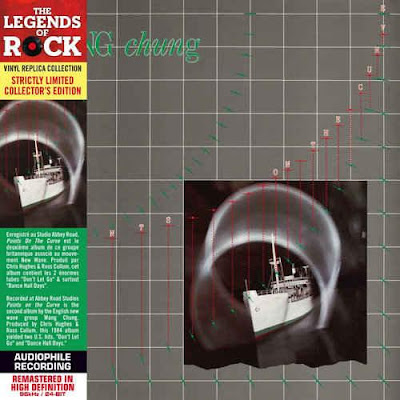
     In 1983, the band reappeared as a trio (Hogg was out), with a modified band name (Wang Chung) and a new label (Geffen). The first single, “Don’t Be My Enemy,” received airplay on U.S. radio stations and the buzz began to grow.  The next single, “Don’t Let Go,” earned frequent MTV plays as well as radio spins. Their second album, Points On The Curve, was released in early 1984 and then the band finally had their first bona-fide ‘big’ hit single with “Dance Hall Days.”  By 1985, Costin had left the band and Hues and Feldman wrote and performed the soundtrack to the William Friedkin-directed To Live And Die In L.A. They also recorded “Fire In The Twilight” for the soundtrack to The Breakfast Club.
     The following year, Wang Chung-mania went global when they released the singles “Everybody Have Fun Tonight,” “Let Go,” and “Hypnotize Me” and the parent album, Mosaic. While the music was slicker than their ’82 debut and Points On The Curve, there was no denying when listening to the songwriting and unique arrangements that this was Wang Chung. The band had moved forward while still retaining their sense of self.  When they released their fifth album, The Warmer Side Of Cool, in 1989, their Art-Rock roots were showing through while their more commercial side took a back seat.  Old fans loved it, of course, but radio couldn’t grasp anything beyond the album’s first single “Praying To A New God” and Wang Chung’s momentum slowed considerably.  By 1990, Wang Chung was put on ice.
   Hues and Feldman have reunited a few times over the next 20+ years, but finally made it semi-permanent when they released their 2012 album Tazer Up! digitally and plotted a tour of the U.S. in 2013.  At a recent rare UK gig, drummer Costin joined the band onstage for an all-too-brief reunion.  As the band prepped for their tour, the Culture Factory label reissued remastered versions of Points On The Curve and Mosaic in beautiful mini-LP sleeves.  With all of this activity, could a revival of Wang Chung-mania be far behind?  Once can only hope so!
     Stephen SPAZ Schnee caught up with Jack Hues as he geared up for their current U.S. tour to discuss the new album, the reissues and all things Wang Chung…

    
SPAZ:  You’ve got a new album, Tazer Up!, plus two reissues (Points On The Curve and Mosaic) and you are just about to start a tour of the U.S.  How are you feeling about things right now?
JACK HUES: I Feel Good NanananananaNa

SPAZ:   Going back to the beginning, I’ve read that you two met through an ad that Nick had placed looking for musicians?  Can you tell us a little about that?
JACK: I had just left the Royal College of Music and had figured out that being the next Mahler was going to be a little more tricky than I imagined. I moved permanently to London with my first wife who was expecting our first son. I earned money teaching guitar, but I looked around for bands to work with and did a few auditions. Nick was the only person who seemed interesting, doing something original - and he had a fantastic drummer - Paul Hammond (RIP) who had recently quit Atomic Rooster. He is still one of the greatest drummers I ever worked with. He could play a straight, unwavering 4/4 beat on bass drum, snare and hi-hat AND roll a cigarette at the same time. He had a great sense of the inner time of a song - not just the surface tempo. Nick was writing these great Punk songs with major 7th chords in them, jazzy sounding chords. Later, I showed Nick some of my songs and was inspired to write for the band and Nick was “big” enough to encourage it - the creative bond was established back in those early days.

SPAZ:  Under the original name of Huang Chung, you released a few indie singles that were considered Post-Punk but actually leaned towards Art-Rock.  Can you tell us about some of your influences?
JACK: The strongest underlying influence at that time was David Bowie. The harmonic/melodic sophistication of “Drive in Saturday” and “Life on Mars,” the Funk-Rock of Station To Station and David Live and the instrumental sides of Heroes and Low. He was a great education for a musician, plus his sense of style and alter-egos. But UK Punk was important for me in blowing away the complacency of looking at “music” as a “trained” musician. I remember Jack Bruce saying he spent 5 years “unlearning” what he had been taught at music college. I’m not sure how you “unlearn” things, but you realize there is a lot more to it than being technically secure. So influences at that time were the Sex Pistols and The Clash, Siouxie And The Banshees, Television, early Blondie, The Tubes, Talking Heads. Also Chic and Chaka Khan for the Funk and Todd Rundgren, Little Feat and Ry Cooder for the playing and the songwriting.


SPAZ:  By the time the self-titled debut had been released, what had inspired you to move in a more sophisticated direction?  The songwriting had a lot more depth than your average chart fodder...
JACK: Growing up listening to The Beatles and 60’s/70’s pop. Part of it’s appeal was that there was a fantastically attractive and exciting surface, but just below it was a subversive “message” speaking directly to you - “I’d love to turn you on” or “Turn off your mind relax and float downstream,” “Everybody must get stoned,” and “Let’s spend the night together,” “You’re not alone”. Also the music sounded simple, but when you learnt to play it, it was constantly shifting in unexpected ways. So, for me, the trick has always been to present an attractive surface that lures the listener in, then challenges them with a strange lyric, or structure or chord change so that they come with you on the journey. Music is particularly effective in communicating directly with the emotions, bypassing linguistic logic, or subverting it, to create a highly personal experience.

SPAZ:  Why didn’t you use a pseudonym like Darwin, Hogg or Nick De Spig?
JACK: Jack Hues is a pseudonym... my real name is Jeremy Ryder. Jack Hues is a play on “J’accuse” - after the pamphlets by Emil Zola and Graham Green - amusingly pretentious I thought at the time...

SPAZ:  Looking back, how do you feel about that debut album? “Hold Back The Tears” is still one of my fave Wang tunes…
JACK: I like it. It is very undiluted in its statement of who we were/are. We made the album with Rhett Davies (Roxy Music) as producer - he did a great job, but there was a lack of vision at the record label and they put us back in the studio to redo some of it with Roger Becherian. Roger is a great guy, part of Blanket of Secrecy, with whom Nick and I worked around that time. Roger was much less interventionist than Rhett and I think his tracks lack the intensity of Rhett’s work. I love Nick’s bass playing on Huang Chung - Rhett got an amazing sound. The Roland Space Echo was the secret weapon on that album!

SPAZ:   Was Huang’s version of “Dance Hall Days” actually released as a single?  I’ve read conflicting reports… and I’ve never actually owned a copy…
JACK: I don’t think it came out. Not with our blessing anyhow. Tim Friese-Greeneproduced it and I hated what he did to it! I get what he was trying to do - to knock us off center and try to create something “new and exciting.” I love his work with Talk Talk, in fact Colour of Spring and Laughing Stock are among my favorite albums by an “80’s band” - well, by any band - but we were not in sympathy in 1982.

SPAZ:  Was the name change to Wang Chung meant to make it easier for the consumer to pronounce the name correctly?
JACK: That was the thinking. Having made the Huang Chung album and been round the block with press and gigs we realized that the name was a barrier to people getting the band. Our little in-joke was not funny to the outside world, so we were ready to change it when we moved to Geffen Records. But we struggled to come up with anything else and David Geffen said he liked the name but that we should re-spell it to make it easy to pronounce. So we did... Huang Chung does have a specific meaning, but the idea was always that we wanted a name that was a “sound” without “meaning.” The Chinese characters that we used for the first album cover further removed the “name” to a “meaningless” realm - “meaningless” in an unattached, Buddhist way. Anyway, changing the spelling seemed to further that process, so I was ok with it.


SPAZ:  With Hogg out and Nick and Darren reverting to their birth names, Points On The Curve was a move forward for the band.  Did you purposely try to create something a little more commercial with this album?
JACK: Taking on David Massey as our manager (without whom we would have not left Arista and signed to Geffen), signing to Geffen, recording with Chris Hughes and Ross Cullum at Abbey Road 2 - all this felt like a big step up. Also “Dance Hall Days” was a huge asset - when I wrote it I played it to Nick and he immediately heard the potential. Everyone we played it to in the business - you could almost see the dollars signs in their eyes and they started to be very nice to us! So I think we realized that “Dance Hall Days” could be a hit, that there was a bigger game to play and that working with Chris was moving things to a higher level. It wasn’t a conscious change - I think all the new people involved created the new version of the sound of the band. So it wasn’t like we were thinking, let’s be more commercial, we were just riding the horse the way it was going.

SPAZ: “Don’t Be My Enemy” was actually the first single and did get some airplay here on KROQ.  Second single “Don’t Let Go” received MTV coverage. And then the hits really kicked in with “Dance Hall Days.”  Do you remember having much say so in what would be picked as a single?
JACK: Not really. In those days, the guys who did promotion at Geffen treated it like an arcane science - I remember they would know chart positions in any given week of hits, how many weeks on the chart, weekly sales - they would just fire numbers at you like it all meant something - so we were happy to leave it to them. But I think there was enormous pressure on them not to f*** it up! So they tried to soften the ground with “Enemy” and “Don’t Let Go” before releasing “Dance Hall Days.” Maybe, with hindsight, it would have been better to go with “Dance Hall” first, but hey - it all worked out ok.

SPAZ:  Were you blindsided when “Dance Hall Days” became as big as it did?  Or had you been preparing for that first big break?
JACK: I think I had been preparing since I was eight years old! But nothing can prepare you for the real thing! I found it exciting, but very stressful and confusing.


SPAZ:  You lost Darren at this point and continued as a duo.  Was it hard to lose another member in such a short time frame?
JACK: A well framed question... Darren is a wonderful person, larger than life in every way and we recently played together again in London at a sort of “homecoming” after 25 years! It was a delight and he raised the whole thing to another level. Making Points On The Curve was not easy for him because 1983 was the year of the Linn Drum and The Fairlight - early computers that were very slow to program and difficult to coax into life. All the drums were done on those machines, and although the drum fills and the approach were all Darren’s work the actual playing was done through programming these bloody computers. So Darren got very bored! The subsequent tour supporting The Cars saw all three of us under pressure in different ways. At the end of all that it felt somehow natural that Darren would do his own thing - he needed the space to express himself and not sit around for another year waiting for the hi-hat part to be finished on a new Wang Chung album.

SPAZ: You were asked to do the soundtrack to To Live And Die In L.A. because William Freidkin was a fan of Points On The Curve, especially the track “Wait.” Was it more of a challenge to write music for a film than the pop charts? Because of your classical background, I was thinking it might be the opposite…
JACK: As you rightly anticipate, it was a tremendous release for me. I was working on the music for what became “City of the Angels” on the soundtrack when Billy called us. Like “Wait,” it had a fast tempo with slow moving chords and I was trying to turn it into a 3 minute pop hit! When we got the call from Billy I turned it into a 12 minute instrumental! Perfect! Haha. You mention my Classical background. In truth I don’t have a Classical background. I learnt guitar and how to read music from the age of 8, but my parents were not into Classical music at all. My grandparents were into “light Classical” music, sort of easy listening Classical, which I loathed and my experience of Classical music as a working class kid in Britain was through comedy shows like Morcambe and Wise and Monty Python taking the piss out of it. I was obsessed with Rock music and all my musical activities were in bands with school friends from around the age of 12. It wasn’t until I was 18 and I went to University that I started to really get into Classical music, indeed I spent all of the 80’s listening to Classical music and learning what I had never known due to my lack of a “Classical background.” My background is 60’s and 70’s Pop/Rock and especially The Beatles, Cream, Hendrix, Led Zep, Yes and Genesis. That is where my penchant for long form structures comes from. You can’t divide these things up neatly - of course there is always going to be an overlap but, to me, having a “Classical background” implies a certain English, middle-class experience and that was not what I had growing up.


SPAZMosaic was a great Pop record but still contained that unique Wang Chung sensibility to it in terms of the songwriting.  Do you feel you reached a pretty good compromise between what you wanted to do and what the label wanted you to do?
JACK: For me personally, Mosaic meant letting go. To Live And Die in LA was a great experience and I think it contains some of our best music, but it was regarded by Geffen as a commercial flop - no number one single. So we were under pressure to create a hit. John Kalodner (our A&R guy at Geffen), Nick and David (our manager) wanted to work with Peter Wolfwho had just had hits with “We Built This City” and “These Dreams.” Peter lived in LA but was originally from Vienna so we created a plan where we would start the album in London, then move to Vienna, then finish it in LA - those were the days!! In Vienna I used to go off round the museums and go to the opera and I left them to get on with it! It sounds like I am distancing myself from Mosaic which I don’t mean to do - there is some great work on that album, but I consciously stepped back on that record and stopped fighting every battle over every little detail. In that sense Mosaic is a much more collaborative record between me, Nick and Peter and yes, a successful compromise.

SPAZ:  “Betrayal” is particularly powerful.  Was that song written from experience?
JACK: It is about a friend of mine. I like that song because it incorporates the central “Love” theme of Tchaikovsky’s “Romeo and Juliet” Fantasy-Overture. The three chord motif that underpins the end of the verse structure, gradually transforms into the much more chromatic version of those chords that Tchaikovsky used. Of course the song is about the break up of a “childhood-sweethearts” romance - as the lyrics unravel the breakdown, recounting “what happened,” the music gradually assembles those fabulous romantic chords so that by the end the “love theme” is in full bloom, even though the relationship is over - the two elements work in opposite directions. Our original demo was much more stark - drum machine and string synth - I never really liked the lush version on the album and that version also has a “chorus” that should never have been there - that song suffered more than most on the record from being straightened out.


SPAZ:  “Everybody Have Fun Tonight”:  big hit then, blessing or curse now?  I happen to think it’s still a great, uplifting Pop track… as is the timeless and joyful “Let’s Go”…
JACK: “Everybody Have Fun Tonight” and “Let’s Go” - they were fun to make, I loved the sessions with Siedah Garrett and the backing singers, the horn players. They come from a good place and represent Peter, Nick and myself working at our best. Blessing or curse? Those songs took us in a different direction from which there was no return - but they have bestowed many blessings upon me, so... I’ll go for blessings.

SPAZ: Three years on, you released the Warmer Side Of Cool album, which found you leaning more towards your arty side. Was it a tough album to make after achieving a huge amount of success with Mosaic?
JACK: Yes - I was trying to say, NO we’re not just a Top 40 MTV band and Nick was shouting YES we are!! This was the pendulum swinging back to me writing arty, complicated stuff and Nick trying to keep us on the commercial rails! And Peter Wolf trying to referee the whole thing. If you listen sympathetically there are some ambitious ideas, but I think I had a lot of work to do on myself, both personally and as a writer - success is not a good teacher, let’s put it like that!

SPAZ:  Were you disappointed that it didn’t do better?
JACK: I guess I was disappointed, Nick too - we felt let down by everyone for not getting behind it. I was very aware of the Geffen guys taking a view on it - essentially, this is never going to fly so lets not spend any more money on it. But hey - welcome to the real world. It’s the music BUSINESS. I think they would have supported another album if we had had the vision to see where we actually were, but with hindsight I think neither Nick nor I could step far enough back to see what was actually there. I remember thinking I just wanted it all to stop so I could get off! But I realize now that the one thing you never do on a roller-coaster is to try and get off!


SPAZ:  Did Wang Chung officially break up or did you just set things aside for a few years?
JACK: There was no “legal” break-up. Nick actually got very ill around that time and I did another soundtrack for Friedkin for his movie The Guardian so that sort of naturally drew us apart. Then David Massey decided to go and work for Sony, so that was like Brian Epstein leaving the Beatles - if you’ll forgive the inflated metaphor. I don’t think things could have been any different really - Saturn was in my Horoscope big time and there was no beating that - I am sort of joking and sort of not...

SPAZ:  Over the last 25 years or so, you recorded an unreleased solo album and worked with Strictly Inc (a duo with GenesisTony Banks) while Nick was ½ of Promised Land (with Culture Club’s Jon Moss). Would you two still get together to write material and see what happened?
JACK: No, not as in the old way of going round to each other’s houses and playing ideas. But once Nick was ensconced as an A&R mogul I used to go and see him and listen to what he was signing and he had me produce a couple of his artists. I produced an album for Arkana which I still consider to be a great record -there was a track called “Skin” which is so advanced in it’s sound world - Ollie Jacobs, Arkana’s front-man is a genius and I don’t say that lightly - but it got lost in all the record company politicking.  I remember going to see Nick one time and he played me “Justify Your Tone” by a young songwriter called Will Bates. I loved it and he said, “I knew you would, but we’re not signing him” - then he played me two horrendous pieces of shit and said, “I knew you’d hate them and we are signing them!!” So we know each other, me and Nickie! But I went home and demo’d “Justify” and it’s on Tazer Up! I love the lyric on that tune. “Kiss my mind and dry my eyes please” - wonderful.

SPAZ:  Your new album, Tazer Up!, is now available.  How did you go about choosing which songs would make the album?
JACK: We worked on it, off and on, over quite a long time - from around 2006. We did set a criteria of making the record like an 80’s record ie. drum machines, synths, electric guitars, but no drum loops, guitar solos... of course there are drum loops and guitar solos because it’s important to contradict yourself... At the same time I released two albums with my “Jazz” group, The-Quartet on Helium Records - Chris Hughes’ label with Chris producing - so I got all my more questionable tendencies out on those records... haha. No, I think the “Jazz” influence is a healthy one. I always put “Jazz” in inverted commas because I am not a Jazz musician per se, but the idiom is one that has transformed my understanding of what music is, and in particular what it is to be a performer. But to answer the question - we selected the best 10 songs, or the 10 that would fit together. There are more and some new ones that will make up another album. We were talking about this year, but it will take longer. But there is a further body of work, fans will be glad to hear.

SPAZTazer Up! is not the Wang Chung of the ‘80s, but it’s uniquely Wang Chung.  Did you have a clear idea in mind when you went about creating the album?
JACK: Love us or feel totally indifferent about us, we do sound like we sound - it takes no effort. It would be impossible not to sound like Wang Chung. So there is no clear conscious thing “in mind”. We like to mix up genres and hop from one thing to another just like bands did in the good old days. Each track on a Beatles album was almost a separate persona - so too The Kinks, Pink Floyd, Led Zep - always creating hybrids unlimited by “genre” - those bands created their “genre” - anyway, we like genre-bending and with a distinctive core sound you can do that.

SPAZ:  At one of your recent London shows, you were joined by original drummer Darren Costin.  Are there plans for him to rejoin the band?
JACK: Yes, we are working with Darren on the recordings from that show and he will play with us again in the UK I’m sure. He will also play on some of the new album so I think Darren will be more involved. I see Wang Chung as a sort of experimental laboratory really, rather than a band. We try out things, we drift into new genres and people come and go - I like that more and more rather than trying to be the same old guys doing the same old thing. In the U.S., we are using American musicians for our upcoming tour.


SPAZ: What’s next for Wang Chung?
JACK: A U.S. summer tour and a new album - some time...

SPAZ:  What are you currently spinning on your CD, LP and DVD players?
JACK:
CD –
Mozart String Quartet in A Major K.464 - The Hagen Quartet
Opposites - Biffy Clyro

LP –
Thelonious Monk plays Duke Ellington
Exile on Main Street reissue - The Rolling Stones

DVD –
Le Règle du Jeu – directed by Jean Renoir
The American Friend – directed by Wim Wenders
Cloud Atlas – directed by The Wachowskis and Tom Tykwer


Thanks to Jack Hues

Special thanks to Jocelynn Pryor, Doug Weber and Richard Le Besnerais


SUMMER 2013 U.S. TOUR DATES

 
Jul 24
Mayo Performing Arts Center w/ The Fixx
Morristown, NJ
 
Jul 25
Erie Canal Harbour Central Wharf w/ The Fixx
Buffalo, NY
 
Jul 26
The Arcadia Theatre w/ The Fixx
St Charles, IL
 
Jul 27
OH-Lounge - Hollywood Casino w/ The Fixx
Columbus, OH
 
Jul 30
Northern Lights Theatre w/ The Fixx
Milwaukee, WI
 
Aug 01
Four Winds Casino Resort - Hard Rock Cafe w/ The Fixx
New Buffalo, MI
 
Aug 03
Santa Clara Fairgrounds
San Jose, CA
 
Aug 04
Assembly
Sacramento, CA
 
Aug 10
Mandalay Bay Beach w/ A Flock of Seagu...
Las Vegas, NV
 
Aug 16
Canyon Club w/ DIZZYLILACS, All...
Agoura Hills, CA
 
Aug 17
The Coach House w/ The Reflexx, You...
San Juan Capistrano, CA
 
Aug 23
New Wave Club
Bellflower, CA
 
Aug 24
Ramona Main Stage
Ramona, CA
 
Aug 31
Stage 305 - Magic City Casino
Miami, FL


POINTS ON A CURVE


MOSAIC