Showing posts with label Mute Records. Show all posts

Thursday, October 6, 2011

An EXCLUSIVE interview with M83!


An EXCLUSIVE interview with M83’s ANTHONY GONZALEZ


By Stephen SPAZ Schnee


     There used to be a time when the double album was a grand and bold musical statement from an artist and not just a regular release with a few remixes added as a bonus. From The Beatles’ White Album and The Who’s Tommy to Led Zeppelin’s Physical Graffiti and Pink Floyd’s The Wall, any band brave enough to release a double album caught the attention of the critics and music fans alike. Even Prince’s 1999 and XTC’s English Settlement set new heights for those artists, attracting more fans than ever. But over the years, the double album has become a real rarity. While you may find many two disc releases on the shelves, the second CD usually contains nothing more than bonus demos, acoustic versions or remixes. In essence, the legitimate double album seems to be a thing of the past… but thank goodness nobody told M83’s Anthony Gonzalez that!
     When Gonzalez moved from his homeland of France to Los Angeles nearly two years ago, his new surroundings inspired a prolific period of songwriting and experimenting with music. Early on, the transplanted Frenchman realized that his vision was much larger than a conventional 45 minute album. The songs that poured out of him began to form an album that would exceed anyone’s expectations, even his own. By the time it was complete, Gonzalez had created a double album that was mysterious, dark and utterly beautiful.
     From Ambient and Electronica to Shoegaze and Dream Pop, Hurry Up, We’re Dreaming is an ambitious project and is the culmination of everything released in M83’s decade-long career. While the band’s sound has progressed over the years, this is an album that takes the best elements from all of their past releases and adds more depth and power to the mix. Hurry Up, We’re Dreaming takes the listener on a trip through different moods and atmospheres and leaves an indelible impression on their senses. This is an album that is raw and powerful yet unabashedly joyful. The album never outstays its welcome: every note is there for a reason and the entire project would feel incomplete were you to remove even one track. This is what double albums are all about.
     Stephen SPAZ Schnee sat down to speak with Anthony about Hurry Up, We’re Dreaming, his inspiration and much more…


SPAZ: Hurry Up, We’re Dreaming is just about ready to drop. How are you feeling about the album and things in your world right about now?
ANTHONY GONZALEZ: I feel excited. I haven’t felt this excited for a long time… maybe since Before The Dawn Heals Us (2005). I feel confident and proud of this record. I’m just so excited to go back on the road and play shows in front of my fans. Sometimes, it’s hard to be a musician. Some people think its all holidays all the time. But sometimes, it’s very stressful. Emotionally, it can be hard to cope with everything. But when you feel good about an album, you’re excited to talk about it and play live shows. You’re looking forward to it. You’re like a kid… you’re just excited about everything.

SPAZ: The album is a very ambitious two CD release. When you started recording the album, did you plan on so many songs making the album or did it evolve over time?
ANTHONY: You never know what to expect when you start composing an album, obviously. But early on, I realized I wanted a double album. We’d been touring a lot for the previous album and being on stage and on the road for such a long time made me realize that I wanted to create a big project. I couldn’t wait to go back into the studio while I was still on the road. When I first moved to L.A. one and a half years ago, I was so excited about being in the studio again. I was enjoying myself so much. I was playing with my keyboard like I’ve never played before. I was experimenting and improvising. That was the first time that happened in many years. When you’re excited about being in the studio, it flows out of you and you keep composing and composing. At the end, you have a lot of songs to pick from. (laughs)

SPAZ: The era and the art of the double album has all but disappeared over the years. Was there ever a time that you felt you should compromise and whittle the album down to an average album-length single disc?
ANTHONY: Yeah, definitely. It’s the wrong time to be releasing a double album. But I thought that if I don’t do it now, it would be even more difficult to release a double album in two, three or five years. But I’ve been working on this album for a year and that’s a long period of time. Sometimes, you start to lose confidence and you start doubting yourself. But other times, you feel proud. I like to feel as if this album is a gift to myself. There was so much pleasure in the making of this album. I was feeling all these different emotions. If I felt like this during the making of the album, hopefully people will feel like this listening to it. So, I said let’s go for it, let’s go double. I didn’t want to have any regrets. I wanted to do something for myself for once.

SPAZ: While the tracks on the album certainly flow together very well, each track has it’s own personality (and in some cases, multiple personalities). Did you initially create the songs as distinct individual tracks, or were you always looking at these tracks falling under a unifying theme?
ANTHONY: I can’t say that all the songs are part of a main theme. Some of them are… the ambient songs and small interludes are part of that theme. But I love pop songs and I wanted this album to have pop songs as well. I think this album is like a combination of all my previous albums together. I wanted to have a lot of different elements: epic songs, slow songs, quiet interludes and pop songs.

SPAZ: Some of the lovely and moving melodies are gentle and understated, while others are powerful and loud. Were the song arrangements dictated by the melodies or did the melodies come out of the song arrangements? Tracks like “Soon, My Friend” and “Reunion” are very different, yet equally effective.
ANTHONY: You know what? I have no idea! (laughs) I’m not waking up and saying to myself “OK, today I’m going to work on an epic track or I’m going to work on a slow interlude.” I write what comes naturally so I don’t have the feeling that its forced. I didn’t have to fight against the songs. It was just a natural progression. It makes sense that some of the songs needed to be very epic and very orchestrated. But you also want to keep some songs very quiet because they didn’t need anything more.

SPAZ: The album, like all of your releases, seem to draw from the last 30 years of Pop, Rock and Electronic music, from Brian Wilson to OMD, yet you manage to maintain a very distinct sound. What influences you?
ANTHONY: A lot of things. This is what I like about being a musician, being an artist: you can be inspired by so many different things. I was moving to a new city (L.A.). I was going out to see movies. I was going out to live shows. I was going to museums. I was reading a lot of books as well. I was just being inspired by anything. Its funny because sometimes I feel like I don’t want to make music because I don’t feel like something good is going to come out of my brain. But for this whole year, I felt so inspired by everything and anything. It could be something simple like meeting a new friend or talking to some people at a party. Or being inspired by a movie you just saw the day before. This album was inspired by one year in my life.
SPAZ: Are you sometimes surprised by your fan’s interpretations of your songs?
ANTHONY: It does surprise me, but in a good way. It’s exactly what I like about music. It’s very different from reading a book where everything is written on a page or watching a movie where everything is up there on the screen. There’s this feeling of freedom and I like that. I can’t wait for people to tell me stories about them listening to the album.

SPAZ: People tend to create their own visuals in their head while listening to the music… Do you think that music videos can take away from a listener’s own personal attachment to a song?
ANTHONY: Yeah, of course. Sometimes, the video can be a perfect match for the music. But sometimes it doesn’t happen that way and that’s a risk. I grew up watching videos during the MTV era. This is part of my culture. I couldn’t picture myself releasing an album with no music videos. Its part of the process of the making of an album.

SPAZ: What’s next for M83?
ANTHONY: I’m really excited to go back on tour. It’s been two years now since we’ve played any shows. I couldn’t be any happier than I am today. I am proud of this album and I’m ready to travel and play this album in front of my fans.

SPAZ: What is currently spinning on your CD and DVD players?
ANTHONY: Recently, I was listening to and love the new Mogwai EP. I’ve also had the chance to listen to the new Zola Jesus album. It’s really, really good and I can’t stop listening to it. On my DVD player, I have Halloween 2 from Rob Zombie. I just saw it two days ago. His Halloween movies are really good movies, honestly. I was a big fan of the original Halloween movies, but… I don’t know… this guy comes from a different planet!

Thanks to Anthony Gonzalez
Special thanks to Jacki Feldstein, Nicole Blonder and Anthony Balboa


M83

HURRY UP, WE'RE DREAMING

10.18.11


Friday, May 6, 2011

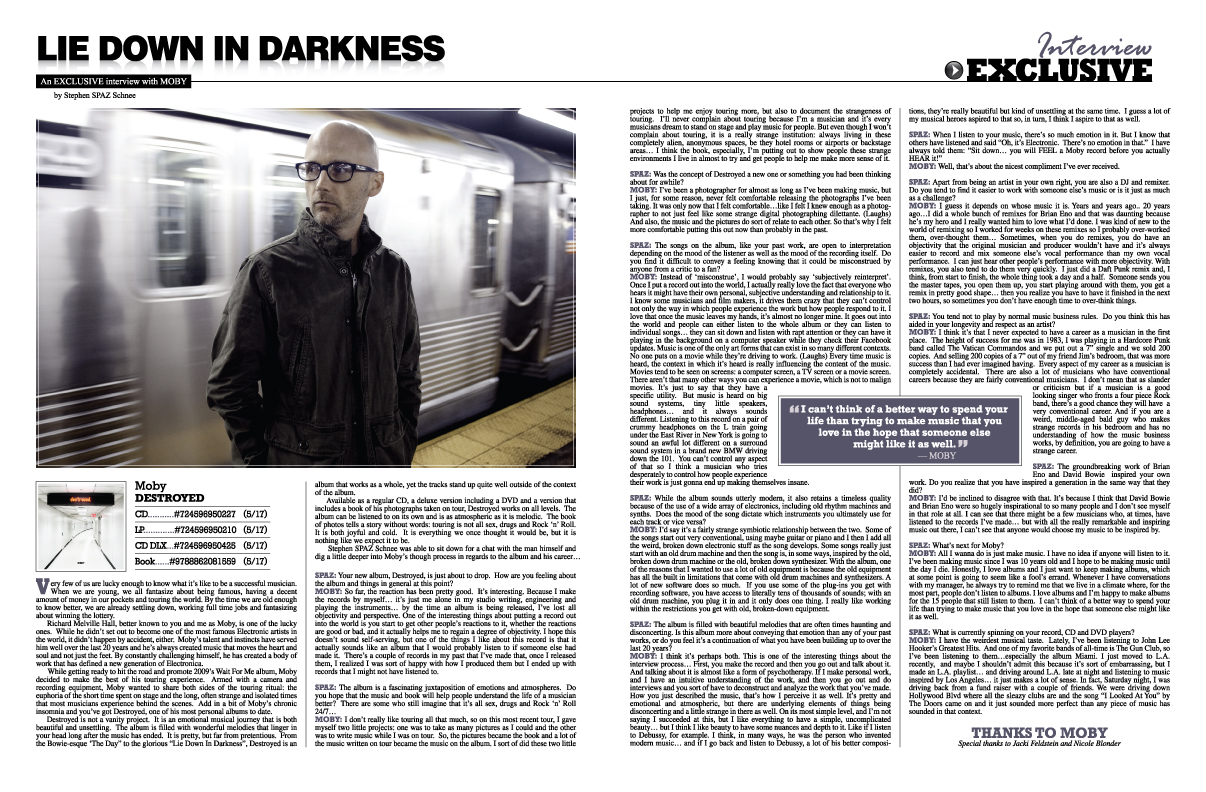
An EXCLUSIVE interview with MOBY!


By Stephen SPAZ Schnee


Very few of us are lucky enough to know what it’s like to be a successful musician. When we are young, we all fantasize about being famous, having a decent amount of money in our pockets and touring the world. By the time we are old enough to know better, we are already settling down, working full time jobs and fantasizing about winning the lottery.
     Richard Melville Hall, better known to you and me as Moby, is one of the lucky ones. While he didn’t set out to become one of the most famous Electronic artists in the world, it didn’t happen by accident, either. Moby’s talent and instincts have served him well over the last 20 years and he’s always created music that moves the heart and soul and not just the feet. By constantly challenging himself, he has created a body of work that has defined a new generation of Electronica.
     While getting ready to hit the road and promote 2009’s Wait For Me album, Moby decided to make the best of his touring experience. Armed with a camera and recording equipment, Moby wanted to share both sides of the touring ritual: the euphoria of the short time spent on stage and the long, often strange and isolated times that most musicians experience behind the scenes. Add in a bit of Moby’s chronic insomnia and you’ve got Destroyed, one of his most personal albums to date.
     Destroyed is not a vanity project. It is an emotional musical journey that is both beautiful and unsettling. The album is filled with wonderful melodies that linger in your head long after the music has ended. It is pretty, but far from pretentious. From the Bowie-esque ‘The Day” to the glorious “Lie Down In Darkness”, Destroyed is an album that works as a whole, yet the tracks stand up quite well outside of the context of the album.
     Available as a regular CD, a deluxe version including a DVD and a version that includes a book of his photographs taken on tour, Destroyed works on all levels. The album can be listened to on its own and is as atmospheric as it is melodic. The book of photos tells a story without words: touring is not all sex, drugs and Rock ‘n’ Roll. It is both joyful and cold. It is everything we once thought it would be, but it is nothing like we expect it to be.
     Stephen SPAZ Schnee was able to sit down for a chat with the man himself and dig a little deeper into Moby’s though process in regards to the album and his career…

SPAZ: Your new album, Destroyed, is just about to drop. How are you feeling about the album and things in general at this point?
MOBY: So far, the reaction has been pretty good. It’s interesting. Because I make the records by myself… it’s just me alone in my studio writing, engineering and playing the instruments… by the time an album is being released, I’ve lost all objectivity and perspective. One of the interesting things about putting a record out into the world is you start to get other people’s reactions to it, whether the reactions are good or bad, and it actually helps me to regain a degree of objectivity. I hope this doesn’t sound self-serving, but one of the things I like about this record is that it actually sounds like an album that I would probably listen to if someone else had made it. There’s a couple of records in my past that I’ve made that, once I released them, I realized I was sort of happy with how I produced them but I ended up with records that I might not have listened to.

SPAZ: The album is a fascinating juxtaposition of emotions and atmospheres. Do you hope that the music and book will help people understand the life of a musician better? There are some who still imagine that it’s all sex, drugs and Rock ‘n’ Roll 24/7…
MOBY: I don’t really like touring all that much, so on this most recent tour, I gave myself two little projects: one was to take as many pictures as I could and the other was to write music while I was on tour. So, the pictures became the book and a lot of the music written on tour became the music on the album. I sort of did these two little projects to help me enjoy touring more, but also to document the strangeness of touring. I’ll never complain about touring because I’m a musician and it’s every musicians dream to stand on stage and play music for people. But even though I won’t complain about touring, it is a really strange institution: always living in these completely alien, anonymous spaces, be they hotel rooms or airports or backstage areas… I think the book, especially, I’m putting out to show people these strange environments I live in almost to try and get people to help me make more sense of it.

SPAZ: Was the concept of Destroyed a new one or something you had been thinking about for awhile?
MOBY: I’ve been a photographer for almost as long as I’ve been making music, but I just, for some reason, never felt comfortable releasing the photographs I’ve been taking. It was only now that I felt comfortable…like I felt I knew enough as a photographer to not just feel like some strange digital photographing dilettante. (Laughs) And also, the music and the pictures do sort of relate to each other. So that’s why I felt more comfortable putting this out now than probably in the past.

SPAZ: The songs on the album, like your past work, are open to interpretation depending on the mood of the listener as well as the mood of the recording itself. Do you find it difficult to convey a feeling knowing that it could be misconstrued by anyone from a critic to a fan?
MOBY: Instead of ‘misconstrue’, I would probably say ‘subjectively reinterpret’. Once I put a record out into the world, I actually really love the fact that everyone who hears it might have their own personal, subjective understanding and relationship to it. I know some musicians and film makers, it drives them crazy that they can’t control not only the way in which people experience the work but how people respond to it. I love that once the music leaves my hands, it’s almost no longer mine. It goes out into the world and people can either listen to the whole album or they can listen to individual songs… they can sit down and listen with rapt attention or they can have it playing in the background on a computer speaker while they check their Facebook updates. Music is one of the only art forms that can exist in so many different contexts. No one puts on a movie while they’re driving to work. (Laughs) Every time music is heard, the context in which it’s heard is really influencing the content of the music. Movies tend to be seen on screens: a computer screen, a TV screen or a movie screen. There aren’t that many other ways you can experience a movie, which is not to malign movies. It’s just to say that they have a specific utility. But music is heard on big sound systems, tiny little speakers, headphones… and it always sounds different. Listening to this record on a pair of crummy headphones on the L train going under the East River in New York is going to sound an awful lot different on a surround sound system in a brand new BMW driving down the 101. You can’t control any aspect of that so I think a musician who tries desperately to control how people experience their work is just gonna end up making themselves insane.

SPAZ: While the album sounds utterly modern, it also retains a timeless quality because of the use of a wide array of electronics, including old rhythm machines and synths. Does the mood of the song dictate which instruments you ultimately use for each track or vice versa?
MOBY: I’d say it’s a fairly strange symbiotic relationship between the two. Some of the songs start out very conventional, using maybe guitar or piano and I then I add all the weird, broken down electronic stuff as the song develops. Some songs really just start with an old drum machine and then the song is, in some ways, inspired by the old, broken down drum machine or the old, broken down synthesizer. With the album, one of the reasons that I wanted to use a lot of old equipment is because the old equipment has all the built in limitations that come with old drum machines and synthesizers. A lot of new software does so much. If you use some of the plug-ins you get with recording software, you have access to literally tens of thousands of sounds; with an old drum machine, you plug it in and it only does one thing. I really like working within the restrictions you get with old, broken-down equipment.

SPAZ: The album is filled with beautiful melodies that are often times haunting and disconcerting. Is this album more about conveying that emotion than any of your past works, or do you feel it’s a continuation of what you have been building up to over the last 20 years?
MOBY: I think it’s perhaps both. This is one of the interesting things about the interview process… First, you make the record and then you go out and talk about it. And talking about it is almost like a form of psychotherapy. If I make personal work, and I have an intuitive understanding of the work, and then you go out and do interviews and you sort of have to deconstruct and analyze the work that you’ve made. How you just described the music, that’s how I perceive it as well. It’s pretty and emotional and atmospheric, but there are underlying elements of things being disconcerting and a little strange in there as well. On its most simple level, and I’m not saying I succeeded at this, but I like everything to have a simple, uncomplicated beauty… but I think I like beauty to have some nuances and depth to it. Like if I listen to Debussy, for example. I think, in many ways, he was the person who invented modern music… and if I go back and listen to Debussy, a lot of his better compositions, they’re really beautiful but kind of unsettling at the same time. I guess a lot of my musical heroes aspired to that so, in turn, I think I aspire to that as well.

SPAZ: When I listen to your music, there’s so much emotion in it. But I know that others have listened and said “Oh, it’s Electronic. There’s no emotion in that.” I have always told them: “Sit down… you will FEEL a Moby record before you actually HEAR it!”
MOBY: Well, that’s about the nicest compliment I’ve ever received.


SPAZ: Apart from being an artist in your own right, you are also a DJ and remixer. Do you tend to find it easier to work with someone else’s music or is it just as much as a challenge?
MOBY: I guess it depends on whose music it is. Years and years ago.. 20 years ago…I did a whole bunch of remixes for Brian Eno and that was daunting because he’s my hero and I really wanted him to love what I’d done. I was kind of new to the world of remixing so I worked for weeks on these remixes so I probably over-worked them, over-thought them… Sometimes, when you do remixes, you do have an objectivity that the original musician and producer wouldn’t have and it’s always easier to record and mix someone else’s vocal performance than my own vocal performance. I can just hear other people’s performance with more objectivity. With remixes, you also tend to do them very quickly. I just did a Daft Punk remix and, I think, from start to finish, the whole thing took a day and a half. Someone sends you the master tapes, you open them up, you start playing around with them, you get a remix in pretty good shape… then you realize you have to have it finished in the next two hours, so sometimes you don’t have enough time to over-think things.

SPAZ: You tend not to play by normal music business rules. Do you think this has aided in your longevity and respect as an artist?
MOBY: I think it’s that I never expected to have a career as a musician in the first place. The height of success for me was in 1983, I was playing in a Hardcore Punk band called The Vatican Commandos and we put out a 7” single and we sold 200 copies. And selling 200 copies of a 7” out of my friend Jim’s bedroom, that was more success than I had ever imagined having. Every aspect of my career as a musician is completely accidental. There are also a lot of musicians who have conventional careers because they are fairly conventional musicians. I don’t mean that as slander or criticism but if a musician is a good looking singer who fronts a four piece Rock band, there’s a good chance they will have a very conventional career. And if you are a weird, middle-aged bald guy who makes strange records in his bedroom and has no understanding of how the music business works, by definition, you are going to have a strange career.

SPAZ: The groundbreaking work of Brian Eno and David Bowie inspired your own work. Do you realize that you have inspired a generation in the same way that they did?
MOBY: I’d be inclined to disagree with that. It’s because I think that David Bowie and Brian Eno were so hugely inspirational to so many people and I don’t see myself in that role at all. I can see that there might be a few musicians who, at times, have listened to the records I’ve made… but with all the really remarkable and inspiring music out there, I can’t see that anyone would choose my music to be inspired by.

SPAZ: What’s next for Moby?
MOBY: All I wanna do is just make music. I have no idea if anyone will listen to it. I’ve been making music since I was 10 years old and I hope to be making music until the day I die. Honestly, I love albums and I just want to keep making albums, which at some point is going to seem like a fool’s errand. Whenever I have conversations with my manager, he always try to remind me that we live in a climate where, for the most part, people don’t listen to albums. I love albums and I’m happy to make albums for the 15 people that still listen to them. I can’t think of a better way to spend your life than trying to make music that you love in the hope that someone else might like it as well.

SPAZ: What is currently spinning on your record, CD and DVD players?
MOBY: I have the weirdest musical taste. Lately, I’ve been listening to John Lee Hooker’s Greatest Hits. And one of my favorite bands of all-time is The Gun Club, so I’ve been listening to them…especially the album Miami. I just moved to L.A. recently, and maybe I shouldn’t admit this because it’s sort of embarrassing, but I made an L.A. playlist… and driving around L.A. late at night and listening to music inspired by Los Angeles… it just makes a lot of sense. In fact, Saturday night, I was driving back from a fund raiser with a couple of friends. We were driving down Hollywood Blvd where all the sleazy clubs are and the song “I Looked At You” by The Doors came on and it just sounded more perfect than any piece of music has sounded in that context.

Thanks to Moby
Special thanks to Jacki Feldstein and Nicole Blonder


Friday, August 6, 2010

YAZ/Reconnected Live (Double CD) Available Sept. 28th, 2010!


YAZ

RECONNECTED LIVE

9.28.10


"I hear you're buying a synthesizer and an arpeggiator, and are throwing your computer out the window because you want to make something real. You want to make a Yaz record." – “Losing My Edge,” LCD Soundsystem

RECONNECTED LIVE documents one of pop’s most anticipated tours: in the summer of 2008 Vince Clarke & Alison Moyet (AKA Yazoo, or Yaz as they are known in the U.S.) reunited for the first time in over 25 years. The Times raved: “Clarke has unobtrusively retooled the band’s music for the digital age, making their vintage 1980s synthesizer ditties sound crisp, fluid and timeless” while The Guardian noted, “Yazoo’s first tour in 26 years finds the chemistry behind their smash hits unchanged.”

RECONNECTED LIVE, produced by Yaz, recorded by Martin Hildred and mixed by Vince Clarke features classic tracks from Yaz’s albums Upstairs At Eric’s and You And Me Both; including 'Only You', 'Don’t Go' and 'Situation' plus tracks performed live for the first time ever, such as 'Nobody’s Diary'.

The joyous, unlikely coming together of Vince Clarke, who had just left Depeche Mode, and Alison Moyet lasted for only 2 albums, performing just 24 concerts worldwide, but left an unforgettable mark on pop. Yaz released Upstairs At Erics in July 1982, parting ways 12 months later upon release of their second album You And Me Both, which reached #1 in the UK.

Speaking prior to the Reconnected tour, Vince Clarke said: "It's been really good going back to these songs after such a long while. Many of them have never been played live. I'm looking forward to performing them with Alison for all the fans who've enjoyed our music through the years but never had a chance to see Yazoo in concert"

Alison Moyet explained: "Playing this material live is not about revision for me, it is about finishing something we started – writing, recording, performing. Three parts of a whole. A salmon cycle. It’s like going home.”

Watch Vince Clarke & Alison Moyet’s pre-show ritual before they played NYC HERE

Tuesday, October 6, 2009