Thursday, August 4, 2011

An EXCLUSIVE interview with JEFF BRIDGES!


By Stephen SPAZ Schnee


     After an affectionate intro by producer and music icon Quincy Jones, rapturous applause greets a humble yet confident Jeff Bridges as he takes to the stage of the legendary Troubadour club in West Hollywood. Flanked by his band, The Abiders, Bridges is here to promote his eponymous Blue Note Records debut, his first album in more than a decade. The club is filled with friends (Ryan Reynolds, T-Bone Burnett, Pierce Brosnan), family (including his wife Susan and his brother Beau) and invited music industry guests, many of whom are unfamiliar with Jeff’s musical history which stretches all the way back to the late ‘60s.
     From the moment the band kicks into set opener “Hold On You,” the world outside the club ceases to exist: Bridges has the audience in the palm of his hand and he does not disappoint during this hour-plus set. Having not graced the Troubadour stage in 40 years, Bridges is remarkably calm and collected, clearly enjoying the overwhelming response to his music. While it’s easy to categorize his style as Country, to be honest, he’s more Tom Waits than Tom T. Hall. The raw honesty and emotional depth that runs through the songs are more akin to Folk and Americana than anything you’d find on a Now That’s What I Call Country compilation.
     Performing seven of the new album’s cuts, Bridges manages to throw in a few favorites from the soundtrack to Crazy Heart, the 2009 film that won him an Academy Award for Best Actor. Apart from winning him the coveted Oscar, Crazy Heart is also significant because it introduced the musical side of Bridges to a wider audience.
     Truth be told, music is not a vanity project for Bridges like it has been for so many other actors (Cory Feldman, come on down!). In fact, music is Jeff’s first love and that fact is plainly obvious from the moment he steps up to the microphone. As Quincy had explained during his introduction, while Jeff and his brother were working with the producer in 1969, Hollywood came calling. Jeff went off to film The Last Picture Show, fully intending to resume his music career once he’d finished his acting commitments. That role earned him his first Academy Award nomination and he never looked back.
     Over the next 40 years, Bridges made his mark as one of Hollywood’s finest and most respected actors. He’s played many memorable roles over the years, but the one role that struck a chord with movie fans was his portrayal of The Dude in the Coen Brothers’ classic 1998 film The Big Lebowski. No matter how high his career flies or how many awards he wins, The Dude is the one role that has connected with so many people around the world. So much so that in the middle of tonight’s set, a fan offers Bridges a White Russian (The Dude’s drink of choice), which he politely refuses with a grin.
     At the end of the set, Bridges performs “The Weary Kind,” the theme to Crazy Heart which was performed by Ryan Bingham on the film’s soundtrack. Bridges’ version is even more emotional than the original and it leaves the audience spellbound. The final song of the evening is a cover of ‘The Man In Me”, the Johnny Cash tune that appears in The Big Lebowski.
     By the time he leaves the stage, everyone has all but forgotten Jeff Bridges, the Oscar-winning actor: they have just met and lovingly embraced Jeff Bridges, singer, songwriter and musician. And it seems that The Dude himself is pretty damn pleased about that.
     A week before the Troubadour show, I was able to sit down and have a chat with Jeff about the album and his musical career up to this point. We were joined by fellow scribe Dave Rayburn, who snuck in a question as well.


SPAZ: Your self-titled album is just about to drop. How are you feeling about the project and your musical career up to this point?
JEFF BRIDGES: I’m over the moon. It’s so wonderful working with my old friends… (producer) T-Bone Burnett and my oldest friend, John Goodwin. That was great. The band that T-Bone put together was just phenomenal. Playing with these guys is just like making a movie: the casting of it is 99% of what makes it either fly or not. And T-Bone cast this so well.

SPAZ: The album is steeped in classic Country, but there are so many elements and layers to each of the songs that they transcend that genre. Did you purposely set out to incorporate so many influences on this project?
JEFF: I didn’t set out to put as many influences as possible, but I am influenced by a lot of different kind of music. One of the things that T-Bone kind of specializes in this sort of… I don’t know what you’d call it… an ‘Alternative Music Universe” or something. It’s sort of genre-less in a way. You feel like there are elements that it relates to, but it’s not in one particular genre: it kind of reinvents it, you know.

SPAZ: The album’s opener, “What A Little Love Can Do”, is like Cosmic Country, pulling in bits and pieces of Country’s past, present and future…
JEFF: That’s true, yeah. It’s also got a little Buddy Holly influence in there, too.

SPAZ: While the tracks are written by a variety of writers, including yourself, was it difficult to keep it as cohesive as it is?
JEFF: Not really. We ended up cutting 17 tunes in 12 days…you know, the rhythm tracks. There’s a wonderful thing that happens when you’re making a movie… I guess any kind of art… For awhile, you’ve got to bring stuff to it to nurture it. Then, after awhile, if things are going well, it starts to tell you what it wants and it starts to direct itself. That’s kind of what happened on this album. There are a lot of good songs that we did, but this was the best combination of songs for this album. We’ve got seven other tunes that I think are just as good that are not on there. It’s just a matter of gathering the material. We started out with about 70 songs and we got it down to just these.

SPAZ: Do you already foresee a Jeff Bridges 2 in the near future?
JEFF: I hope so, yeah! The music is there, we’ve got these great players and T-Bone, if he’s up for it again, it would be wonderful if it all falls into place. I guess it’s kind of like what they say about getting pregnant. When a woman has a child, she’s all “let’s do it again!” (laughs). You gotta really watch it if you don’t wanna get pregnant, not to go fooling around… and I fool around with music all the time! So, who knows?

SPAZ: Coming from a music lover’s background, when putting the tracklist together, did you envision this project as a record with two distinct sides?
JEFF: When we were making the music, we didn’t think of it in those terms, no. When they knew that they were going to make a vinyl of it, then we had to have ‘two sides’.

SPAZ: You’ve been friends with T-Bone Burnett for over 30 years. Does he instinctively know what sound you were trying to achieve and was he usually successful in translating what was in your head and putting it down on tape?
JEFF: When we went through all these songs to try to figure out what songs we were gonna do, he was really looking for something unique, something that was uniquely me, and I really appreciated that. That’s what he was bringing out with the musicians that he brought together. I specifically asked for those guys, too, because I’m a giant fan of every one of them.

DAVID RAYBURN: With names like T-Bone Burnett, Ryan Bingham, John Goodwin, Gary Nicholson, and late Stephen Bruton appearing as some of the common denominators on consecutive music projects, can you tell us something about the history of some of these friendships?
JEFF: A: Yeah, well, you know, John Goodwin and I, we go back to the 4th grade together. He’s one of my oldest friends and we’ve been writing music for, maybe not that long, but certainly maybe 30 or 40 years. We’d paint and do all sorts of creative things together. He’s a Nashville writer. Very prolific. So, we’ve been writing together and supporting each other’s music for a long time. With T-Bone and Stephen Bruton, we met on Heaven’s Gate 30 years ago. Kris Kristofferson, who starred in that movie, brought a bunch of his musician friends on board to play small roles. We had T-Bone and Stephen, Norton Buffalo, Ronnie Hawkins, a whole slew of just great players, wonderful musicians. And so, Crazy Heart kind of came out of that relationship with Stephen and T-Bone and I had back in those days. And this album was just kind of a natural growth out of Crazy Heart.

SPAZ: While some actors have dabbled in music, it’s been a major part of your life. While many have known of your musical talents, do you think Crazy Heart has made it easier for the public to realize that music isn’t just some part-time vanity project for you?
JEFF: A: Yeah, I think so. I hope so. I mean, that’s one of the reasons that it seemed like the right time to make some music and put out an album because it was in that same atmosphere that Crazy Heart came out of, and was seen by a lot of people. A lot of people seemed to enjoy that. So, yeah… I’m hoping that will help people enjoy it.

SPAZ: Now, what would you say is the difference between selecting the songs for Crazy Heart and this record? Weren’t there a couple songs that were leftover from Crazy Heart?
JEFF: Yeah, well you know John Goodwin supplied a song for Crazy Heart… that “Hold On You” song, the opening one is one of his tunes. And a couple of the Bruton tunes were being thought of for Crazy Heart as well. That song “Nothing Yet” was thought of, but you can only have so many songs in the movie, you know. All the songs that we liked that we had in the movie we really liked. Not that the other songs… we didn’t like… it’s just that there’s only so many places, you know?

SPAZ: You’ve already shown your worth in acting, art and music. Any desire to take that next step to Broadway?
JEFF: (Pauses) I wouldn’t totally poo-poo the idea, but it’s not something I’m actively pursuing in any way!

SPAZ: What’s next for Jeff Bridges?
JEFF: I’m going to be playing a lot of music up ‘till September. We’re going to be playing Sturgis, that big motorcycle rally. We’re going to be doing Austin City Limits. I’ll be doing a bunch of shows here in California. Then, in September, I’ll be putting my acting hat back on and I’ll be doing a movie with Ryan Reynolds called R.I.P.D. I’m pretty much booked solid doing music until then. I’m also the national spokesperson for a campaign called No Kid Hungry (http://www.nokidhungry.org/) and I’m working on that as well.

SPAZ: What do you currently have spinning on your CD player?
JEFF: I’m listening to my buddies. I like Benji Hughes a lot. I don’t know if you are familiar with any of his tunes, but he’s got a wonderful album called A Love Extreme. I’m loving a lot of Marc Ribot music. He’s got a great album called Don’t Blame Me. I love that. He’s got a wonderful Cuban album that I love. And also love Johnny Goodwin’s stuff. I’ve got so many people that I’m close to that are wonderful musicians and that’s what I’m listening to, mainly.

SPAZ: What would The Dude think of this album?
THE DUDE: Oh, he would like it, man! He’d listen to it… he’d put it on his player right between the whales and Creedence, man!

Thanks to Jeff Bridges

Special thanks to Jacki Feldstein, Saul Shapiro, Dave Rayburn and Kimberly McCoy.


JEFF BRIDGES


JEFF BRIDGES


8.16.11


Saturday, July 30, 2011

SPAZ reviews THE AMBASSADORS OF HOLLYWOOD


     If you’ve ever been a tourist in a strange, but exciting city (and I’m sure most of you have), then you’ve seen them in practically every tourist town in America, from theme parks to fried chicken stands: average people dressing up as famous cartoon and movie characters, enchanting the kids and posing for pictures with the family.  Most of the time, these ‘characters’ are minimum wage employees sponsored by local businesses and theme parks with the sole intention of entertaining patrons. . 
     If you walk down
Hollywood Boulevard
, you are likely to come across a myriad of these costumed characters along the way, especially in front of Grauman's Chinese Theater.  Often times, these may be the first people to greet tourists as they take their inaugural stroll through one of the most famous cities in the world. For better or worse, these are the unofficial ‘Ambassadors Of Hollywood’.
     From Elmo to Batman, Snow White to Captain Jack Sparrow, these ‘characters’ that mingle with hundreds if not thousands of people daily are not employed by the city of Hollywood or any of the businesses that line the street. They work strictly on tips and this most likely is their only source of income. While some of the faces behind the masks are out of work actors and comedians waiting until their next paying gig, most of them are homeless and, in many cases, emotionally unstable. Welcome to Hollywood!
     In Ambassadors Of Hollywood, filmmakers Archie Gips and Matthew Hunt take an intimate and often-times uncomfortable look at the real people behind these characters. From a troubled, semi-racist ex-con to a former Wall Street banker, each and every one of the film’s subjects is fascinating. Even though a few of them are as down-to-earth and likable as anyone you could meet, there are a handful of them that probably should not be allowed to mix with the general public at all. Some of these misguided miscreants have uncontrollable tempers while others are aggressively seeking money for their next fix.  The reason that Ambassadors Of Hollywood is so successful is that it takes an unbiased look at each of the individuals and leaves judgment up to the viewer.
     While there have been similar films made about this very subject, including the excellent Confessions Of A Superhero, this is a film that offers up a gritty, humorous sometimes disturbing but always fascinating glimpse into these seemingly innocent characters and the real people behind them.
     Growing up, almost every kid has a dream to become a rich and famous celebrity, but at some point, we’ve all abandoned those dreams and pursued more realistic goals. In Ambassadors Of Hollywood, we meet a group of people who have never given up on their dreams although society has all but given up on them. The film manages to show a darker, but still hopeful, side of the American Dream that we all can relate to.  While some may seem delusional on the surface, if you look hard enough, you will notice that they have never lost hope that their big break is just around the next corner.  And perhaps it is…
     In many ways, Ambassadors Of Hollywood is a reflection of life in any town. From the once-successful to the ne’er do well, these are the same types of people that you meet every single day. The only difference is these guys and gals are wearing costumes! 

Thursday, July 7, 2011

THE MOTELS/Apocalypso (The Lost 1981 Album): Available on August 9th, 2011


Los Angeles, CA - Omnivore Recordings has announced they will officially release The Motels' legendary, lost 1981 album Apocalypso on August 9 in celebration of the 30th anniversary of its recording. Apocalypso will be released in its intended original form as a 10-track LP (on limited-edition orange vinyl). In addition, Omnivore Recordings will release Apocalypso as an expanded 17-track CD version that includes previously unissued original demos and outtakes.

In 1981, Los Angeles band The Motels convened to record the follow-up to their 1980 release Careful. The band's lineup consisted of Martha Davis (vocals/guitar), Marty Jourard (sax/keys), Michael Goodroe (bass), Brian Glascock (drums), and Davis' then boyfriend, Tim McGovern (guitar), who had recently replaced founding member Jeff Jourard.

"So it was" says Davis, "a band, on their third attempt to gain some commercial success in the U.S. A relationship quantified by music and qualified by its abusive nature-and of course there was the Art, that most magical place of expression-'tear down the walls,' 'piss in the face of tradition,' 'make something no one has ever heard before'-and in the '80s there were a lot of drugs, which might explain all of the above. We did as all bands do-locked ourselves away in a room with a tape machine and started making demos, a heady, wonderful experience, where we made up the rules. Tim's influence and command over the process is not to be overlooked."

"On the last day of March we met with producer Val Garay at his Record One studio in Sherman Oaks," recalls Marty Jourard. "After listening to a couple of the songs on the cassette, he immediately agreed to produce the album. He was coming off a huge success with 'Bette Davis Eyes' and was the hot producer of the month. In my recollection it was Tim making most of the production decisions and Val engineering, but opinions may vary. We recorded from April to August. On July 23rd the album cover was shot. It was fun watching Martha being photographed surrounded by fire. The final album session was August 9th from 1 p.m. to 7 a.m.-we drank a lot of coffee!-recording overdubs for 'Art Fails.' We were done."

"When we were convinced we had amassed the perfect collection of what were obvious hits or at least great album tracks, we went to the label," says Davis.

As Capitol A&R man Bruce Ravid recalls, "having cosigned the band, I was one of the A&R guys who thought that this album was 'too strange, too dark, and where's the single?' It was very much a Tim McGovern record that seemed like too great a departure for The Motels. This was a crucial release for the band, as we knew we needed to get them on radio in a big way. There was an unusual amount of love for The Motels at Capitol from the day we signed them, and we really needed consensus from the promotion, sales, and marketing people downstairs. It's true, our promotion execs didn't feel they had a shot with Apocalypso. We dreaded the thought of telling the band they needed to return to the well."

"When Capitol heard the album the reaction was something like, 'We'll release it if you really want us to, but the promotion department will not work it,' says Davis.

Davis sums up what happened next: "After the bruising of egos, and some time to reflect, it was apparent that this was actually a good thing. It was long past time for Tim and I to part ways and this was the opportunity to get out of a bad relationship. So Tim was gone and with him the album Capitol didn't want to release."

The resulting album All Four One was released in 1982 as The Motels' official third studio record and was the band's first commercial success, featuring the timeless "Only The Lonely," which would go Top 10 on the Billboard charts; the subsequent video would become a staple of rotation on the burgeoning music television network MTV.

"With the hindsight that only 30 years can bring, I hear Apocalypso as a sort of wild sonic ride," says Jourard. "All Four One was our first real commercial success, but it was born of these sessions."

"All Four One came out, and we had our first real chart success in the U.S.-we were mainstream, baby...But something was lost with Apocalypso, the album that got away," says Davis. "I look at it as the last time The Motels were uninhibited, wild, and not worried about our place on the charts. In my heart, I think I've always liked Apocalypso more."

Apocalypso track list:

1) Art Fails *
2) Tragic Surf
3) Only The Lonely
4) Schneekin'
5) So L.A.
6) Apocalypso *
7) Mission Of Mercy
8) Lost But Not Forgotten
9) Who Could Resist That Face *
10) Sweet Destiny *

Bonus Tracks

11) Art Fails (alternate version) *
12) Don't You Remember (4-track demo) *
13) Tragic Surf (4-track demo) *
14) Fiasco (4-track demo) *
15) Obvioso (4-track demo) *
16) Only The Lonely (4-track demo) *
17) Only The Lonely (TV Mix - hidden track) *

(*) previously unissued track

Friday, July 1, 2011

An EXCLUSIVE Interview with CHRIS SQUIRE from YES!


By Stephen SPAZ Schnee

In one form or another, Yes has been creating music for over four decades. In the late ‘60s, they were an underground band with a unique sound, but it wasn’t until the early ‘70s that the band achieved massive worldwide success. Perhaps more than any other band from that era, Yes wrote the Progressive Rock rulebook and every Prog band that followed in their wake took inspiration from them.

When Punk came along in the late ‘70s and attempted to destroy the popularity of bands like Yes, the headstrong Progsters may have lost the attention and adulation of the always-fickle press, they never lost the dedication of their fanbase. Even when vocalist Jon Anderson and keyboardist Rick Wakeman left the fold, the band bounced back in 1980 with the album Drama featuring vocalist Trevor Horn and keyboardist Geoff Downes (both of Synthpop duo The Buggles) in their place. While the band disintegrated shortly after that, they weren’t gone long before a new line-up emerged with their most successful album yet, the Trevor Horn-produced 90125, which included the massive hit “Owner Of A Lonely Heart”.
Since then, the band have continued to evolve with slightly different line-ups and fresh, new approaches to their sound. In 2008, Jon Anderson experienced respiratory issues and the band’s touring plans were put on ice. After realizing that they may not be able to tour with Anderson, a replacement was sought and vocalist Benoit David, formerly of Yes tribute band Close To The Edge, fit the bill.
With the line-up of bassist Chris Squire, guitarist Steve Howe, drummer Alan White, vocalist Benoit David and keyboardist Oliver Wakeman (son of Rick), the band entered the studio with producer Trevor Horn and began work on their first studio album in 10 years, Fly From Here. Soon after recording began, Wakeman left the band and was replaced by Geoff Downes. While this line-up was practically a recreation of the Drama-era version of the band, many fans were expecting an album that picked up where that album left off. But Fly From Here is certainly no carbon copy of that album. Instead, this project takes elements from all periods of Yes’ career and creates a fresh and exciting new beast altogether. It is most definitely a Yes album and contains all the elements that fans have come to love, but it’s also an album that stands well on its own and has the potential to attract a new generation of listeners. Simply put, Fly From Here is their best album in years.
Stephen SPAZ Schnee was able to catch up with Chris Squire, who was kind enough to discuss the new album and so much more…


SPAZ: Fly From Here is just about ready to drop. How are you feeling about the album and Yes’ musical journey thus far?
CHRIS SQUIRE: Feeling very good. We’re all extremely happy about how the album turned out. All the interviews I’ve done with people who have heard it, they’ve all been very positive. So, everything seems good.

SPAZ: Fly From Here is the first studio album in 10 years. What inspired the band to record the album now, as opposed to getting things together a few years ago?
CHRIS: Yeah, our last studio album was in 2001, the Magnification album, which was with an orchestra. After that was released, we spent the next two or three years pretty much going around, promoting it with various orchestras, in different parts of the world. So, a couple of years go by quite easily like that. Then Jon Anderson started to have problems with his respiratory system and his voice, so we laid low for awhile to see how that would all pan out. We were planning to go back on the road when he felt good in 2008. Just before we started rehearsing for the tour, he had another attack, unfortunately, so we had to make a decision at that point to get Benoit (David, vocalist) into the band. Of course, we spent the next couple of years going on the road making sure that Benoit was the right man for the job, getting him up to speed with the whole touring experience, etc. Then we decided that it was time to do a new album, so we started working on that. By the time we got ‘round to going into the studio, it was nearly 10 years since the last one! It certainly wasn’t intentional.

SPAZ: The album has that classic Yes sound, yet is also very much a modern-sounding album.
CHRIS: When you say ‘modern’, you mean sonically?
SPAZ: Yes, sonically, which is probably due to Trevor’s production, but the album does not sound ‘dated’ at all. It sounds completely new and fresh, musically.
CHRIS: Yeah.
SPAZ: Did you purposely try to fit the best of both worlds into the album, or did this all fall together organically?
CHRIS: I think more organic. Usually, in my experience, the outcome of any album is a combination of all the people involved in making it, starting, obviously with the music and singing. But then it goes beyond that because we were working with Trevor again and he has his own team of people that he’s been working with. He’s very current with modern recording techniques. So we definitely wanted to make the music itself be organic and we definitely wanted to play everything as opposed to having machines building the tracks up, which of course, is common place more than not these days. We wanted to get the element of a real band playing. We added the benefit of modern equipment to that as well. It does come out feeling like a modern sounding record and Trevor’s team did a great job at that.

SPAZ: Geoff Downes was a late addition to the line-up. Did it take much convincing to get him involved with the project?
CHRIS: Not really. It was a late decision. We’d already started making the album. Oliver Wakeman (keyboardist) was involved. It just came to a certain point when Trevor Horn decided that he did want to be involved in the production of the WHOLE album… Originally, we were just going to be working on the one song with him, but that seemed to go so well that we carried on doing more with Trevor. He said “If that’s the case, I think you guys will make a better record with Geoff.” Not that there’s anything wrong with Oliver Wakeman’s playing at all. He just thought the flavor that Geoff brings with his style and his keyboard sounds was going to help us to make a better record. I’ve always enjoyed working with Geoff, so we agreed to go and do it that way.


SPAZ: Your vocal turn on “The Man You Always Wanted Me To Be” is amazing. How did you come about doing that track and why not sing lead on more of the album’s tracks?
CHRIS: That tune is the one song that I actually completely wrote 100%. When I was in London in 2007, I was doing a lot of writing and that was one of the songs that I wrote during that period of time. Then I made this album with Steve Hackett called The Squackett Album, which hasn’t been released yet even though it’s been finished for a year. That was one of the songs that was supposed to go on that album, but we didn’t really need it because we had plenty of other material. So I put it forward as a suggestion for the Yes album. We did do a version with Benoit singing, actually, in a higher key because that suited his voice better. But Trevor decided that it would be better if I sang it, so we went along with that.
SPAZ: That was a great decision by Trevor because, in my opinion, it’s one of the highpoints of the album.
CHRIS: Thank you very much!

SPAZ: While the album may be considered a ‘return to form’ by some fans and critics, does that sometimes frustrate you since Yes has always been a consistent band that evolves and changes over the years?
CHRIS: I don’t think it’s a question of going back. I mean, I know that I have a press quote out there about the album where I say I think the album represents some of Yes’ best qualities from the ‘70s and the ‘80s but, as you obviously agree, with a modern twist to it. I couldn’t really ask for anything more. To me, it does feel like a progression. It’s a very clean sounding record. This Swedish journalist said to me that it’s like the lightest record and, at the same time, the darkest record we’ve made. And think I kind of understand what he means by that. I think we’ve definitely achieved another notch in the Yes success belt.

SPAZ: The playing on the album is exceptional, but more importantly, it’s a beautiful piece of work from start to finish. Are you usually conscious of the atmosphere and beauty in your music while recording, or does it all seem to hit you afterwards?
CHRIS: I think it develops as it goes on. There’s no doubt that everyone was in a good frame of mind and enthusiastic. There wasn’t too much bickering… I mean, there’s always discussions… but generally, everyone had an attitude with a smile while we were making the record and it definitely seems to shine through in the end product.

SPAZ: You’ve been doing this a long time. Are there still moments when you listen to a playback and get chills?
CHRIS: Yes, there have been. With Trevor’s main engineer, Tim Weidner, who we’ve worked with before on the Magnification album… One day, when he’d been working on the balancing and the sounds on “The Man You Always Wanted Me To Be”, I walked into the studio and I thought, ‘Fuck that sounds really good!” (laughs).

SPAZ: Was it a conscious effort for Yes to pick up from where Drama left off in expanding upon and recording “We Can Fly From Here", given the return of Geoff & Trevor?
CHRIS: Obviously there’s gonna be an element of that because the return of Geoff. He does have a distinctive keyboard style. When he and Steve play with Yes, it seems to open up the possibilities more than their work with Asia.

SPAZ: Many fans are likely to find Fly From Here to be the most consistent Yes album in years. Are we likely to see this line-up return to the studio in the near future to try to capture a bit more lightning in the bottle?
CHRIS: Oh yeah, I sincerely hope so. The bigger mark the album leaves in a successful way, there’s a lot more chance where that could happen. So, it seems on track for that possibility.

SPAZ: After all of these years, you are still considered one of Rock’s greatest bass players. Is it humbling to know that so many people have been touched by the work you’ve done over the years?
CHRIS: Yeah, it’s definitely a great feeling. I do hear quite a lot from other musicians and I read articles where I’m cited as an influence and I’m very proud about that. Who wouldn’t be, really?

SPAZ: What’s next for Chris Squire and Yes?
CHRIS: We’re going to go out on the road for at least a few years to promote this album. I’ve also go plans for the Squackett album to come out, hopefully in the fall. It’s been already finished for a year, but we haven’t quite nailed down the schedule for releasing that yet. All I know is that between those things, I’m setting myself up to be quite busy.

SPAZ: What is currently spinning on your CD player?
CHRIS: A lot of bands I consider to be new aren’t really new anymore, like the Red Hot Chili Peppers, No Doubt and bands like that that I really like. The Foo Fighters have just put out a great new album and I’m a big fan of them. Sometimes, I’ll just put on the current Top 20 urban hits. You gotta like some of Rihanna’s stuff. I don’t have any prejudices: I’ll listen to classical music, straightforward Pop…. Probably like many people my age, I’m more drawn to putting the comedy channel on over the music channels. (laughs) I will put American Idol on, things like that. I just keep an open mind.

Thanks to Chris Squire

Special thanks to Jacki Feldstein, Shawn Potter, Chris Anderson and Gayland Morris


7.12.11

Wednesday, May 25, 2011

JESSICA 6/See The Light: Available June 7th, 2011


2011 release, the incredible debut album from New York's super talented hipsters. Jessica 6 deftly meld their sound into an inspired modern day take on paradise Garage, New Jack Swing, noir Pop and Disco Soul, all with a pronounced twist of rugged R&B.  With See The Light, Jessica 6 have created a raw portrait of life in their beloved city and the highs and lows that come with it. A shadowy cinematic theme runs through their sound giving it a drama and edge that's influenced by the twisted other worldliness of Twin Peaks and Blade Runner as well as classic horror films. The album is timeless and contemporary in equal measure, darkly emotive but with a massive pop sensibility.


Thursday, May 19, 2011

THE VACCINES/What Did You Expect From The Vaccines?: released in the U.S. on May 31st, 2011!


2011 debut from the hotly-tipped British Indie outfit. The unprecedented reaction and interest surrounding the band has been remarkable with some media comparing the organic hype to the likes of The Strokes. What Did You Expect From The Vaccines? was recorded in a couple of weeks during the autumn of 2010 at RAK and Miloco Hoxton Square studios, London with Dan Grech. The band released their debut double A-sided single, "Wreckin' Bar (Ra Ra Ra)" and "Blow It Up" through Marshall Teller in November 2010 and "Post Break Up Sex", their debut release for Columbia, came out in January of this year.

Friday, May 6, 2011

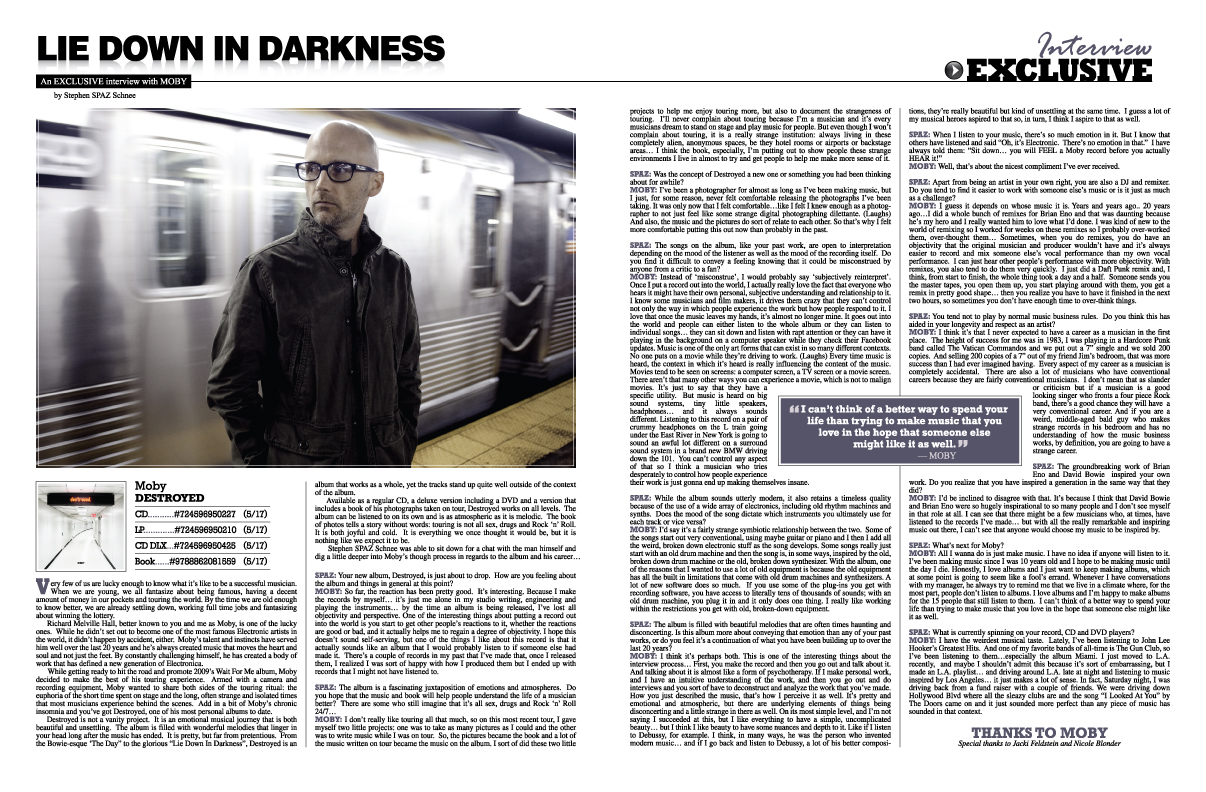
An EXCLUSIVE interview with MOBY!


By Stephen SPAZ Schnee


Very few of us are lucky enough to know what it’s like to be a successful musician. When we are young, we all fantasize about being famous, having a decent amount of money in our pockets and touring the world. By the time we are old enough to know better, we are already settling down, working full time jobs and fantasizing about winning the lottery.
     Richard Melville Hall, better known to you and me as Moby, is one of the lucky ones. While he didn’t set out to become one of the most famous Electronic artists in the world, it didn’t happen by accident, either. Moby’s talent and instincts have served him well over the last 20 years and he’s always created music that moves the heart and soul and not just the feet. By constantly challenging himself, he has created a body of work that has defined a new generation of Electronica.
     While getting ready to hit the road and promote 2009’s Wait For Me album, Moby decided to make the best of his touring experience. Armed with a camera and recording equipment, Moby wanted to share both sides of the touring ritual: the euphoria of the short time spent on stage and the long, often strange and isolated times that most musicians experience behind the scenes. Add in a bit of Moby’s chronic insomnia and you’ve got Destroyed, one of his most personal albums to date.
     Destroyed is not a vanity project. It is an emotional musical journey that is both beautiful and unsettling. The album is filled with wonderful melodies that linger in your head long after the music has ended. It is pretty, but far from pretentious. From the Bowie-esque ‘The Day” to the glorious “Lie Down In Darkness”, Destroyed is an album that works as a whole, yet the tracks stand up quite well outside of the context of the album.
     Available as a regular CD, a deluxe version including a DVD and a version that includes a book of his photographs taken on tour, Destroyed works on all levels. The album can be listened to on its own and is as atmospheric as it is melodic. The book of photos tells a story without words: touring is not all sex, drugs and Rock ‘n’ Roll. It is both joyful and cold. It is everything we once thought it would be, but it is nothing like we expect it to be.
     Stephen SPAZ Schnee was able to sit down for a chat with the man himself and dig a little deeper into Moby’s though process in regards to the album and his career…

SPAZ: Your new album, Destroyed, is just about to drop. How are you feeling about the album and things in general at this point?
MOBY: So far, the reaction has been pretty good. It’s interesting. Because I make the records by myself… it’s just me alone in my studio writing, engineering and playing the instruments… by the time an album is being released, I’ve lost all objectivity and perspective. One of the interesting things about putting a record out into the world is you start to get other people’s reactions to it, whether the reactions are good or bad, and it actually helps me to regain a degree of objectivity. I hope this doesn’t sound self-serving, but one of the things I like about this record is that it actually sounds like an album that I would probably listen to if someone else had made it. There’s a couple of records in my past that I’ve made that, once I released them, I realized I was sort of happy with how I produced them but I ended up with records that I might not have listened to.

SPAZ: The album is a fascinating juxtaposition of emotions and atmospheres. Do you hope that the music and book will help people understand the life of a musician better? There are some who still imagine that it’s all sex, drugs and Rock ‘n’ Roll 24/7…
MOBY: I don’t really like touring all that much, so on this most recent tour, I gave myself two little projects: one was to take as many pictures as I could and the other was to write music while I was on tour. So, the pictures became the book and a lot of the music written on tour became the music on the album. I sort of did these two little projects to help me enjoy touring more, but also to document the strangeness of touring. I’ll never complain about touring because I’m a musician and it’s every musicians dream to stand on stage and play music for people. But even though I won’t complain about touring, it is a really strange institution: always living in these completely alien, anonymous spaces, be they hotel rooms or airports or backstage areas… I think the book, especially, I’m putting out to show people these strange environments I live in almost to try and get people to help me make more sense of it.

SPAZ: Was the concept of Destroyed a new one or something you had been thinking about for awhile?
MOBY: I’ve been a photographer for almost as long as I’ve been making music, but I just, for some reason, never felt comfortable releasing the photographs I’ve been taking. It was only now that I felt comfortable…like I felt I knew enough as a photographer to not just feel like some strange digital photographing dilettante. (Laughs) And also, the music and the pictures do sort of relate to each other. So that’s why I felt more comfortable putting this out now than probably in the past.

SPAZ: The songs on the album, like your past work, are open to interpretation depending on the mood of the listener as well as the mood of the recording itself. Do you find it difficult to convey a feeling knowing that it could be misconstrued by anyone from a critic to a fan?
MOBY: Instead of ‘misconstrue’, I would probably say ‘subjectively reinterpret’. Once I put a record out into the world, I actually really love the fact that everyone who hears it might have their own personal, subjective understanding and relationship to it. I know some musicians and film makers, it drives them crazy that they can’t control not only the way in which people experience the work but how people respond to it. I love that once the music leaves my hands, it’s almost no longer mine. It goes out into the world and people can either listen to the whole album or they can listen to individual songs… they can sit down and listen with rapt attention or they can have it playing in the background on a computer speaker while they check their Facebook updates. Music is one of the only art forms that can exist in so many different contexts. No one puts on a movie while they’re driving to work. (Laughs) Every time music is heard, the context in which it’s heard is really influencing the content of the music. Movies tend to be seen on screens: a computer screen, a TV screen or a movie screen. There aren’t that many other ways you can experience a movie, which is not to malign movies. It’s just to say that they have a specific utility. But music is heard on big sound systems, tiny little speakers, headphones… and it always sounds different. Listening to this record on a pair of crummy headphones on the L train going under the East River in New York is going to sound an awful lot different on a surround sound system in a brand new BMW driving down the 101. You can’t control any aspect of that so I think a musician who tries desperately to control how people experience their work is just gonna end up making themselves insane.

SPAZ: While the album sounds utterly modern, it also retains a timeless quality because of the use of a wide array of electronics, including old rhythm machines and synths. Does the mood of the song dictate which instruments you ultimately use for each track or vice versa?
MOBY: I’d say it’s a fairly strange symbiotic relationship between the two. Some of the songs start out very conventional, using maybe guitar or piano and I then I add all the weird, broken down electronic stuff as the song develops. Some songs really just start with an old drum machine and then the song is, in some ways, inspired by the old, broken down drum machine or the old, broken down synthesizer. With the album, one of the reasons that I wanted to use a lot of old equipment is because the old equipment has all the built in limitations that come with old drum machines and synthesizers. A lot of new software does so much. If you use some of the plug-ins you get with recording software, you have access to literally tens of thousands of sounds; with an old drum machine, you plug it in and it only does one thing. I really like working within the restrictions you get with old, broken-down equipment.

SPAZ: The album is filled with beautiful melodies that are often times haunting and disconcerting. Is this album more about conveying that emotion than any of your past works, or do you feel it’s a continuation of what you have been building up to over the last 20 years?
MOBY: I think it’s perhaps both. This is one of the interesting things about the interview process… First, you make the record and then you go out and talk about it. And talking about it is almost like a form of psychotherapy. If I make personal work, and I have an intuitive understanding of the work, and then you go out and do interviews and you sort of have to deconstruct and analyze the work that you’ve made. How you just described the music, that’s how I perceive it as well. It’s pretty and emotional and atmospheric, but there are underlying elements of things being disconcerting and a little strange in there as well. On its most simple level, and I’m not saying I succeeded at this, but I like everything to have a simple, uncomplicated beauty… but I think I like beauty to have some nuances and depth to it. Like if I listen to Debussy, for example. I think, in many ways, he was the person who invented modern music… and if I go back and listen to Debussy, a lot of his better compositions, they’re really beautiful but kind of unsettling at the same time. I guess a lot of my musical heroes aspired to that so, in turn, I think I aspire to that as well.

SPAZ: When I listen to your music, there’s so much emotion in it. But I know that others have listened and said “Oh, it’s Electronic. There’s no emotion in that.” I have always told them: “Sit down… you will FEEL a Moby record before you actually HEAR it!”
MOBY: Well, that’s about the nicest compliment I’ve ever received.


SPAZ: Apart from being an artist in your own right, you are also a DJ and remixer. Do you tend to find it easier to work with someone else’s music or is it just as much as a challenge?
MOBY: I guess it depends on whose music it is. Years and years ago.. 20 years ago…I did a whole bunch of remixes for Brian Eno and that was daunting because he’s my hero and I really wanted him to love what I’d done. I was kind of new to the world of remixing so I worked for weeks on these remixes so I probably over-worked them, over-thought them… Sometimes, when you do remixes, you do have an objectivity that the original musician and producer wouldn’t have and it’s always easier to record and mix someone else’s vocal performance than my own vocal performance. I can just hear other people’s performance with more objectivity. With remixes, you also tend to do them very quickly. I just did a Daft Punk remix and, I think, from start to finish, the whole thing took a day and a half. Someone sends you the master tapes, you open them up, you start playing around with them, you get a remix in pretty good shape… then you realize you have to have it finished in the next two hours, so sometimes you don’t have enough time to over-think things.

SPAZ: You tend not to play by normal music business rules. Do you think this has aided in your longevity and respect as an artist?
MOBY: I think it’s that I never expected to have a career as a musician in the first place. The height of success for me was in 1983, I was playing in a Hardcore Punk band called The Vatican Commandos and we put out a 7” single and we sold 200 copies. And selling 200 copies of a 7” out of my friend Jim’s bedroom, that was more success than I had ever imagined having. Every aspect of my career as a musician is completely accidental. There are also a lot of musicians who have conventional careers because they are fairly conventional musicians. I don’t mean that as slander or criticism but if a musician is a good looking singer who fronts a four piece Rock band, there’s a good chance they will have a very conventional career. And if you are a weird, middle-aged bald guy who makes strange records in his bedroom and has no understanding of how the music business works, by definition, you are going to have a strange career.

SPAZ: The groundbreaking work of Brian Eno and David Bowie inspired your own work. Do you realize that you have inspired a generation in the same way that they did?
MOBY: I’d be inclined to disagree with that. It’s because I think that David Bowie and Brian Eno were so hugely inspirational to so many people and I don’t see myself in that role at all. I can see that there might be a few musicians who, at times, have listened to the records I’ve made… but with all the really remarkable and inspiring music out there, I can’t see that anyone would choose my music to be inspired by.

SPAZ: What’s next for Moby?
MOBY: All I wanna do is just make music. I have no idea if anyone will listen to it. I’ve been making music since I was 10 years old and I hope to be making music until the day I die. Honestly, I love albums and I just want to keep making albums, which at some point is going to seem like a fool’s errand. Whenever I have conversations with my manager, he always try to remind me that we live in a climate where, for the most part, people don’t listen to albums. I love albums and I’m happy to make albums for the 15 people that still listen to them. I can’t think of a better way to spend your life than trying to make music that you love in the hope that someone else might like it as well.

SPAZ: What is currently spinning on your record, CD and DVD players?
MOBY: I have the weirdest musical taste. Lately, I’ve been listening to John Lee Hooker’s Greatest Hits. And one of my favorite bands of all-time is The Gun Club, so I’ve been listening to them…especially the album Miami. I just moved to L.A. recently, and maybe I shouldn’t admit this because it’s sort of embarrassing, but I made an L.A. playlist… and driving around L.A. late at night and listening to music inspired by Los Angeles… it just makes a lot of sense. In fact, Saturday night, I was driving back from a fund raiser with a couple of friends. We were driving down Hollywood Blvd where all the sleazy clubs are and the song “I Looked At You” by The Doors came on and it just sounded more perfect than any piece of music has sounded in that context.

Thanks to Moby
Special thanks to Jacki Feldstein and Nicole Blonder